The Charga-Plate
1928 · Embossed Charge Token Imprinter · Work 736 of 1,871
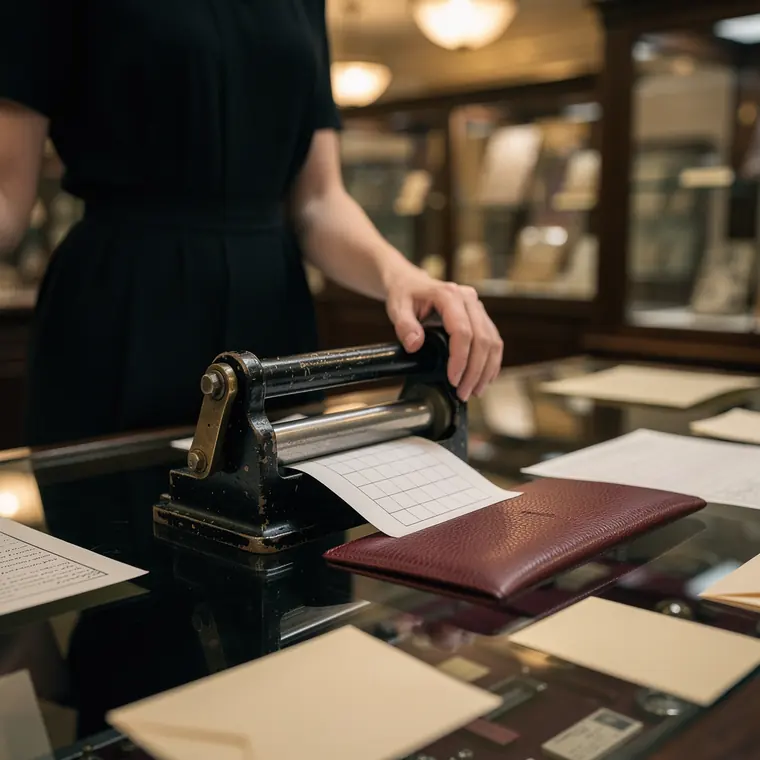
A small charge-account imprinting device of 1928 on the glass top of a sales desk in an American department store, a hand-sized block of black enamelled cast metal with a short pressing lever, in its bed a small thin rectangle of silver-grey sheet metal, embossed side down, about six centimetres long and three wide with rolled long edges, over it a pale sales slip showing only a faint grid of fine lines, beside it a slim sleeve of grained wine- red leather lying smooth back up, a saleswoman seen from behind in a dark dress with her hand on the lever, glass showcases soft in focus, warm light from frosted ceiling bowls.
- What it was used for
- An identification plate for buying on account at a single department store. The Heinz History Center describes an example from Gimbel Brothers in Pittsburgh: a small aluminium plate with raised lettering - name, street, town, account number - together with a paper card bearing the holder's signature in ink, both in a leather sleeve about 4 x 6.7 cm. By the account of Virginia Tech's university library, the clerk put the plate with a sales slip into a small imprinter roughly the size of a stapler; pressing it down transferred name and data onto the slip through a ribbon. The customer then paid the bill or used a revolving credit account. The plate was developed in 1928 by the Farrington Manufacturing Co.
- What was new
- What was new was that the customer's details were no longer copied out but printed: the slip came off the plate in one movement, and notches on the edge coded, according to Virginia Tech, the city (round) and the store (square). What the plate could not do was verify: identity hung on the paper card, which carried a line for the signature; the O'Shaughnessy family example described in Virginia remained unsigned, according to the source because the family never used it. The barb: because the plate was restricted to local stores, the rise of general credit cards from the 1950s sealed its eventual end; the same source, however, traces advertisements into the 1970s and in isolated cases as late as 1981.