The Transorma
1931 · Keyboard Letter Sorting Machine · Work 738 of 1,871
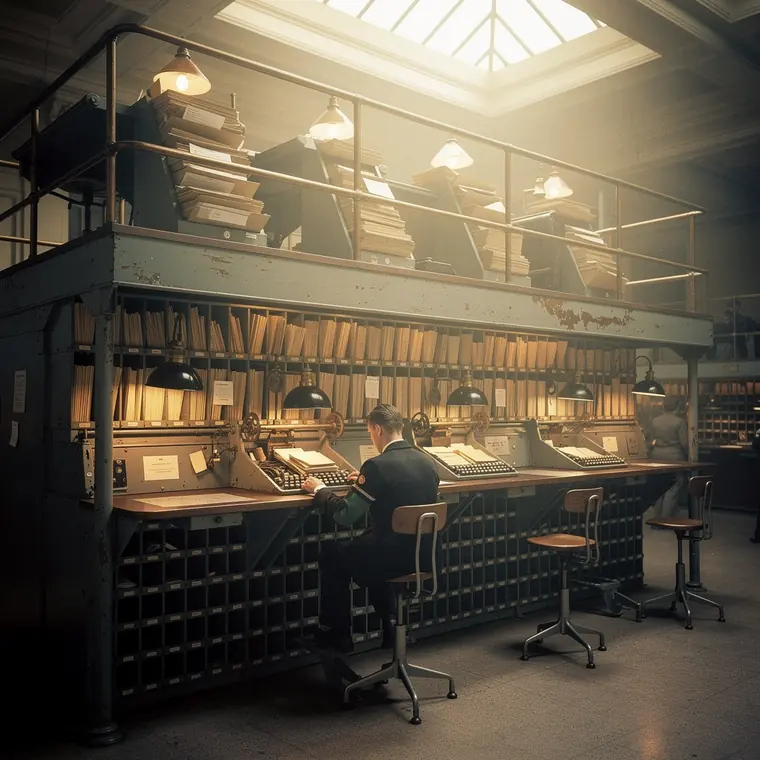
A letter sorting machine of 1931 in a top-lit hall of the main post office in Rotterdam, a two-storey structure of grey painted sheet steel, on its upper gallery behind a tubular railing five operator places in a row, each with a long sloping feed trough holding envelopes standing on edge, a small keyboard sunk into the desk, its small round key tops seen at a slant as pale dots, a black enamel shaded lamp and a revolving stool, below the gallery a long wall of tall narrow open receptacles in five tiers, a postal clerk in sleeve protectors seen from behind at the middle place, daylight from the skylight.
- What it was used for
- The Transorma was a letter-sorting machine for post offices; the name was built from Transporting, Sorting and the names of its originators, chief engineer Marchand and Professor Andriessen in Delft. The prototype was built at N.V. de Pletterij vh. L. I. Enthoven & Co in Delft and series production went to Werkspoor in Utrecht; the first machine was installed in Rotterdam in 1931. Each operator keyed a memorised code for every letter, the machine carried it to a box and printed a letter combination on the envelope; each machine location had a range assigned to it, Utrecht for instance AA to BL. According to the Great Britain Philatelic Society the British Post Office began automatic sorting at Brighton in 1935 "using a Dutch TRANSORMA machine".
- What was new
- What was new was separating reading from carrying: the human decided, the machine transported. The Dutch philatelic account gives 3,000 letters per hour against up to 1,800 by hand; the Smithsonian National Postal Museum describes a Transorma tested in a U.S. post office in 1957 with 5 operator positions, 300 separations and 15,000 letters, cards and circulars per hour - roughly twice what the same number of clerks managed by hand. The barb: the machine did not relieve the sorter of memory. He had to know the codes by heart; the relief was in the walking, not in the knowing.
What the sources leave open: The throughput figures describe different installations and must be read with care; per operator, however, they agree: the Dutch account gives 3,000 pieces of mail per hour for one postal clerk, the Smithsonian 15,000 per hour with five operators.