The Airgraph
1941 · Microfilm Letter Service · Work 740 of 1,871
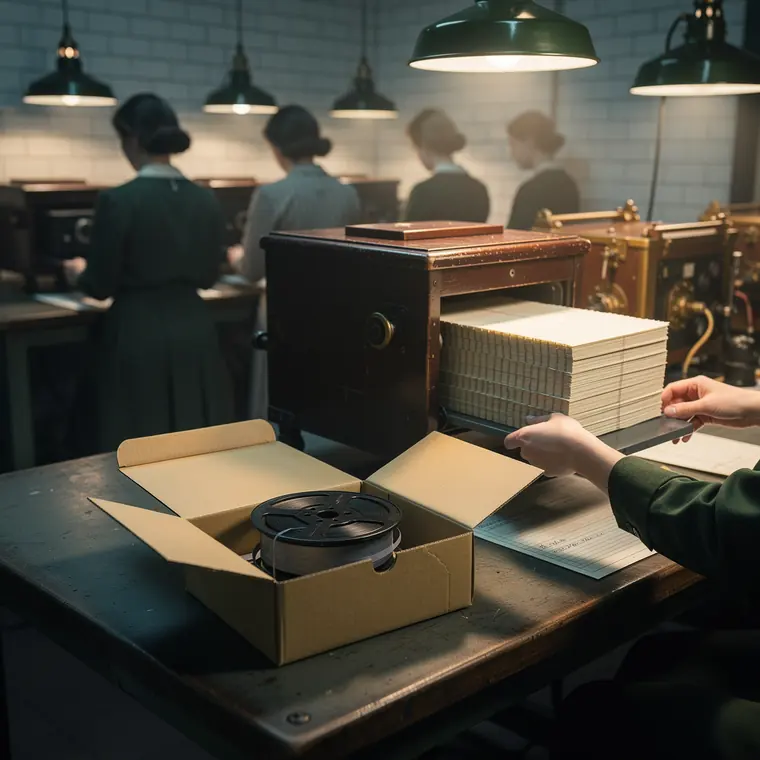
A microfilm letter service workroom of 1941 in London, on a steel table a small square box of plain buff cardboard with its flap open, in it a black spool holding a small reel of narrow grey film, beside the table a recording camera cabinet, a dark brown chest-shaped box about ninety centimetres high on short legs with a flat lid, at its side a low feed shelf where two women's hands slide in a single ruled sheet lying flat, a tall stack of identical sheets seen edge-on, further cabinets in a row with women seen from behind, white glazed brick walls, cold light from enamel shaded lamps above.
- What it was used for
- A way of flying forces mail as microfilm. The sender wrote on a prescribed form, the post photographed it, the film flew, and at the far end Kodak enlarged the message onto a small sheet that went into an envelope. According to the Postal Museum the service began in May 1941, developed by the GPO, Kodak and BOAC, because the Mediterranean route had become dangerous after Italy entered the war in 1940; Kodak supplied film and Recordak cameras and BOAC flew the rolls. One roll of film weighed about 155 grams and carried up to 1,700 letters. The Postal Museum gives, on GPO figures, some 300 million airgraphs handled worldwide between 1941 and 1945.
- What was new
- Microfilming was not new - Kodak brought its existing Recordak cameras to the job. Nor was it new that what arrived was not the sender's sheet but a photographic print of it: the Postal Museum names as the model the pigeon post during the siege of Paris in 1870, when letters were photographed and enlarged on arrival. The price was a division of labour: the Postal Museum describes the chain as women in London offices and at Kodak's Harrow works, often on half-day shifts, French women in Algiers sorting 12 hours a day 7 days a week, and Egyptian boys enveloping and sealing 100,000 to 150,000 airgraphs a day. The barb: the service was closed on 31 July 1945 because traffic declined as cheaper, improved air letters became more widely available; the war had also ended and the air routes were no longer impeded.