ERNIE
1957 · Electronic Random Number Generator · Work 741 of 1,871
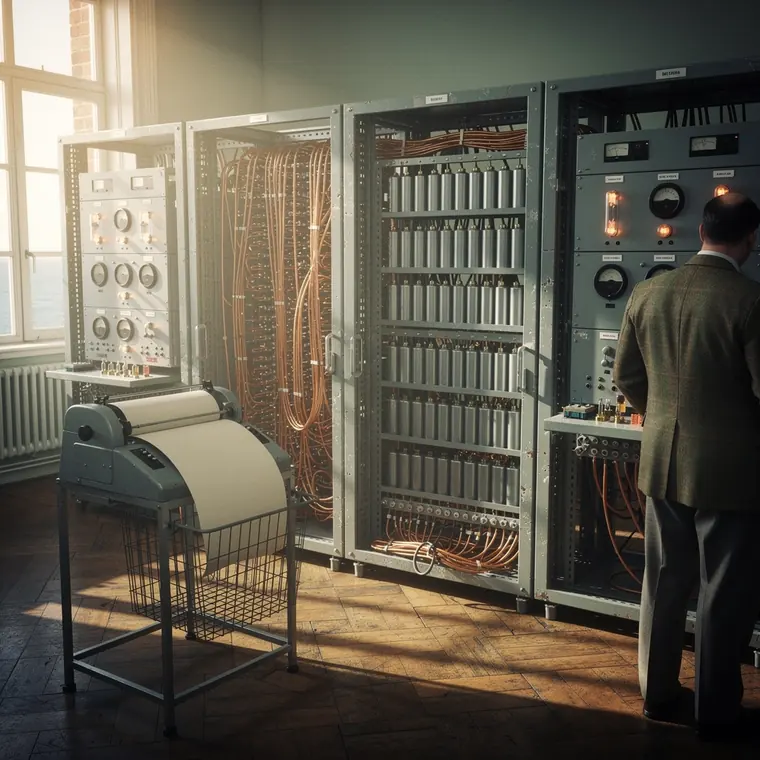
An electronic random number machine of 1957 in a bright hall of a savings office on the coast of Lancashire in England, five open steel equipment racks side by side, together three metres wide and two metres thirty high, painted pale grey, the middle rack filled with dense vertical bundles of orange-brown wiring, the next holding a grid of narrow upright grey metal cans, the outer racks carrying grey boxes each with a round dark window, two small glass tubes glowing orange, in front a teleprinter feeding a narrow paper strip into a wire basket, an engineer seen from behind in a tweed jacket, parquet floor, daylight from tall windows on the left.
- What it was used for
- ERNIE, Electronic Random Number Indicating Equipment, drew the winning numbers of Britain's Premium Bonds. It was built at the Post Office Research Station at Dollis Hill, in 1957 according to the Science Museum; Sidney Broadhurst led the work and Tommy Flowers and Harry Fensom designed it - the same men who had built Colossus during the war. The random numbers came from the electronic noise of neon tubes. The Science Museum lists printed circuits, 1,600 transistors and over 1,000 ferrite cores in which the numbers were counted and stored. The first winning number was drawn on 1 June 1957.
- What was new
- What set it apart was the source of the result: not a drum of tickets but a physical process inside the machine itself, noise counted into digits. That cost time. The Science Museum states that ERNIE took 16 minutes to produce the first nine-digit winning number and ran for over 55 hours in all to complete the first draw; NS&I gives 2,000 numbers per hour and three days for that first draw. The barb: a machine meant to be unpredictable had to prove its unpredictability - the Science Museum names the mathematician Stephanie Brook, later Dame Stephanie Shirley, who worked on the statistics for that; NS&I names the original system for testing its randomness as "Pegasus", designed by Shirley. ERNIE 1 was in service, according to NS&I, from June 1957 to January 1973 and paid out prizes worth £303,779,900.
What the sources leave open: The sources assign the roles differently: the talk report names a “team led by Sidney Broadhurst” with Tommy Flowers and Harry Fensom as designers; according to NS&I, Flowers “was given the project to oversee the delivery” and Fensom “was its chief engineer”. For ERNIE 2 the report gives 1972, NS&I February 1973.