ELSIE
1959 · Single-Position Sorting Machine · Work 744 of 1,871
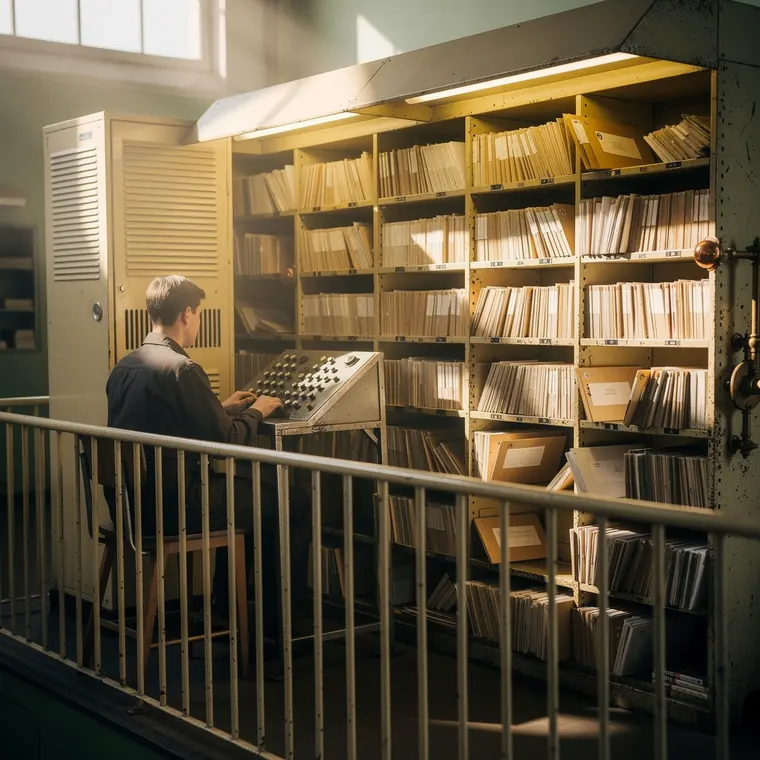
A single-position envelope sorting machine of 1959 in a sorting office in eastern England, a wall of open pigeon-hole boxes about two metres high and five metres long, six tiers of boxes in pale cream painted sheet steel, each box holding envelopes seen edge-on, a shallow lamp canopy along its top, a waist-high railing of thin white steel bars in front of it, at the left end a tall cream machine cabinet with louvred vents and one operator seated before it, seen from behind in a dark jacket, hands on a small sloping desk of round key tops seen at a slant as pale dots, daylight from roof windows above left.
- What it was used for
- ELSIE — Electronic Letter Sorting Indicating Equipment — was a letter sorting machine developed, according to The Postal Museum, by the British Post Office in the early 1950s; the name that endured was SPLSM, Single Position Letter Sorting Machine. One operator per machine read the address and keyed the code, and the machine dropped the letter into the matching pocket. Norwich got the trial because the city already had 8 new sorting machines, which were adapted so that operators could key in the postcode. The Postmaster General opened the experiment, per The Postal Museum, on Tuesday 28 July 1959; the codes had 6 characters, for example NOR 09N.
- What was new
- What was new was not machine sorting — per Spink's INSIDER, the Transorma had been installed at Brighton in the late 1920s — but the order of things: here the address was rewritten for the machine. The Postal Museum records that after the war the Post Office decided "a nationwide postal coding scheme was required to enable mail to be sorted automatically by machine"; the code came out of the machine's need, not the reverse. The trial went badly: the machines kept breaking down, and "Less than half of all letters posted bore codes". The barb is in the ending. The national rollout, announced in 1965 by Postmaster General Tony Benn, began at Croydon in 1966 and was completed in 1974 — with the recoding of Norwich. The first coded city was the last to exchange its code.
What the sources leave open: Assessments differ: the Postal Museum reports constant breakdowns and fewer than half of the letters coded; Spink INSIDER calls the Norwich trial a success and ELSIE “the first successful British sorting machine”.