The Letter Sorting Wall
1959 · Multi-Position Sorting Machine · Work 746 of 1,871
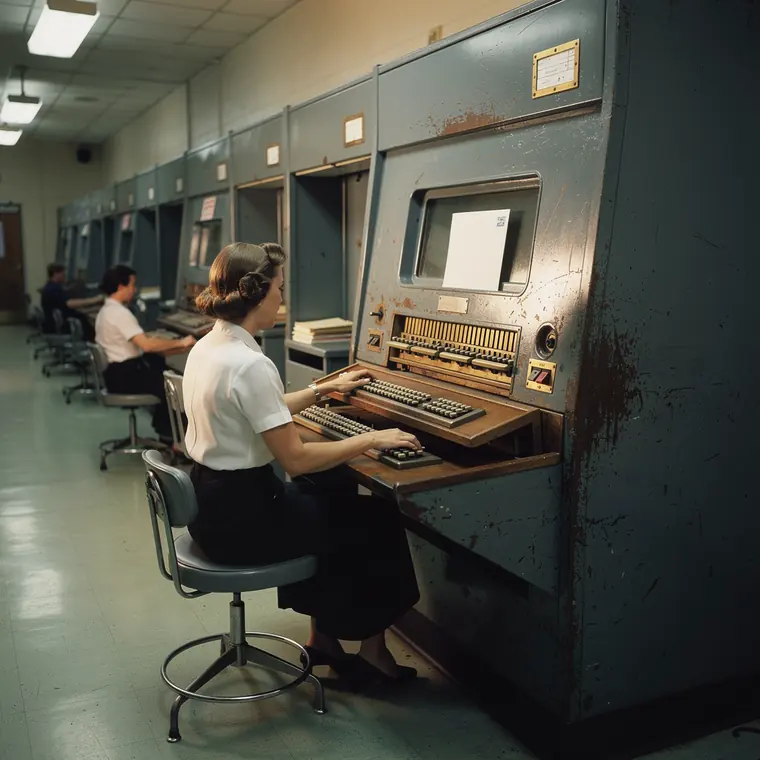
A multi-position envelope sorting machine of 1959 in a windowless hall of a post office in Michigan, a wall of grey painted steel panels twenty-three metres long and two metres seventy high, twelve seating bays set into its front at equal spacing, in the nearest bay a woman in a short-sleeved white blouse seen obliquely from behind on a swivel stool, both hands on two stepped rows of ten long narrow smooth keys each, before her at eye level a narrow window in which one single envelope stands upright, back side toward the lens, the other eleven bays receding along the wall, pale green linoleum floor, cool even light from fluorescent tubes overhead.
- What it was used for
- The multiposition letter sorting machine was a wall of operator consoles: each operator read the address, pressed a key pattern, and the machine dropped the letter into one of hundreds of pockets. By the postal service's own account, the first American-built multiposition letter sorter was developed in the late 1950s, was successfully tested in Detroit in 1959 and derived from a 1,000-pocket machine; the first production contract, for 10 machines, went to the Burroughs Corporation. The National Postal Museum writes that in 1959 Burroughs debuted the first American-built letter sorting machine, at the time the world's largest. Before that, from 1957, a foreign-built Transorma was tested in an American post office: by the postal service's account, 5 operators, 300 separations, about 15,000 pieces per hour.
- What was new
- What was new can only be put cautiously: multiposition sorting already existed in American trial service with the Transorma in 1957. The 1959 machine was, by the postal service's account, the first built in the country, and the National Postal Museum calls it the world's largest at the time. The Transorma, by the postal service's account, managed 300 separations at 15,000 pieces per hour; by 1968 the machines made 160 to 279 separations at up to 43,200 letters per hour. The price was paid by the staff. The museum distinguishes keysort machines, where operators knew the key patterns by heart, from codesort machines using a code derived from the address. Keysorting demanded memory work. In 1968, 137 machines ran in 37 offices; a year later, 205 in 79.
What the sources leave open: The National Postal Museum calls the Burroughs machine the first American-built letter sorting machine; Publication 100 says more precisely “MPLSM” and names older American letter sorters, the Gehring Mail Distributing Machine (from the 1910s) and the Sestack Letter Sorter (1940s).