Project Turnkey
1960 · Automated Post Office · Work 747 of 1,871
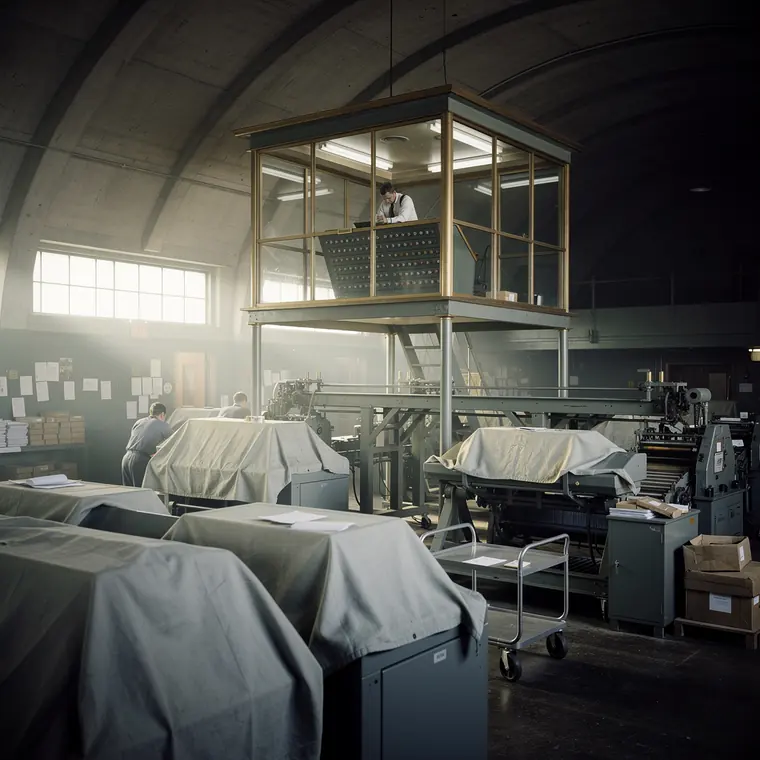
The control tower inside a new mechanised post office hall of 1960 in Providence in Rhode Island, a glazed control room raised on four steel columns, its flat roof at seven metres sixty, glass panes all around in slim steel frames, inside it a man seen from behind in a white shirt at a sloping desk with rows of small lamps, around the tower under a roof of wide curved concrete shells grey conveyor belts on steel trestles and grey sheet-steel sorting machines, several of them standing still under pale canvas dust sheets, two workers seen from behind at a hand cart, daylight from long bands of windows on the left.
- What it was used for
- Project Turnkey was the post office built around its machines: Providence, Rhode Island, placed in service on 20 October 1960. According to the National Postal Museum it was designed, built and operated under contract with Intelex, a subsidiary of International Telephone & Telegraph — the Post Office bought not equipment but a finished plant complete with its operation. The hall was one storey with only 2 supporting columns, 420 feet long, 300 feet wide, 55 feet high, 126,000 square feet under a parabolic roof, with about 3 miles of conveyor belts. Stated capacities: cullers and facer-cancelers 25,000 pieces per hour, letter sorter 18,000 letters per hour to 30 destinations, parcel sorter 4,800 packages per hour to 31 outlets.
- What was new
- What was new above all was the contracting: one contractor delivered building, equipment and operation turnkey, and the floor plan followed the flow of mail. The barb is the headcount. According to the National Postal Museum, 1,500 people worked there, 100 more than in the old post office, plus 70 Intelex employees; many machines were underused or never used, and operators were not adequately trained. The museum quotes a House subcommittee's damning verdict and reports that Postmaster General J. Edward Day said the plant had been advertised as fully automated but was not operating as one. Critics nicknamed it Project Turkey. The stamp for the building sold better than the building worked: 833,306 copies on the first day of issue.