The Card Imprinter
1960 · Manual Carbon Slip Imprinter · Work 748 of 1,871
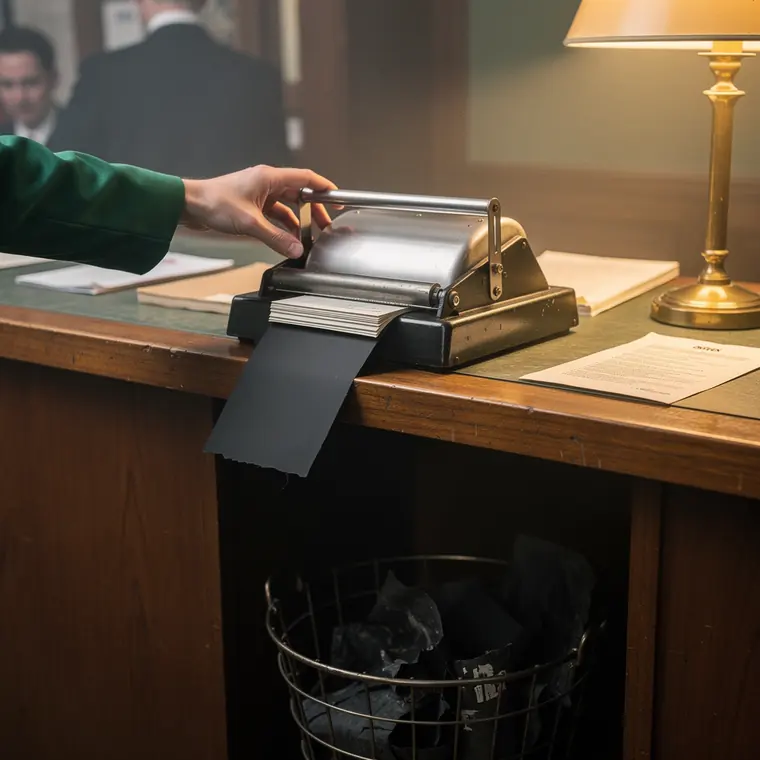
A manual imprinting device of 1960 on the teak counter of a hotel reception in Canada, flat and oblong, thirty-three centimetres long, seventeen wide and twelve high, its base black and grey with a flat bed of bare aluminium, across the bed a low wedge-shaped carriage hood with a handle on two side rails, under the carriage a paper slip of several thin layers at a flat angle, its lowest layer a dark carbon sheet hanging out at the side, a hand in a green jacket sleeve pulling the carriage, under the counter a wire wastepaper basket holding crumpled dark carbon sheets, warm light from a counter lamp on the right.
- What it was used for
- The imprinter was the merchant's counter device: the embossed card went into the frame, a set of forms on top, the bar was drawn across once, and the name and account number came out printed through onto several sheets. The National Museum of American History describes such a device, model 925 NE5 from Canada: it allowed merchants "to transfer account information from the raised name and account number on cards" onto several sheets "for accounting by the retailer, bank and customer with speed and accuracy". The museum dates the object to 1960 to 1990 and lists Citicorp Establishment Services as maker and user; it gives the dimensions as 12.7 by 33.02 by 17.78 centimetres. The slips went to merchant, bank and customer.
- What was new
- The imprinter itself was no innovation — embossed plates and imprinting devices existed from the 1920s, see work 736 — and the Smithsonian dates its example to 1960 to 1990, and to about 1960 in its description. What was new was the card's material: Mobile Transaction calls American Express's 1959 card the first plastic one and says earlier payment cards were cardboard; only the embossed lettering on the plastic card, it says, made the imprint on carbon slips possible. The barb: Mobile Transaction writes that some shops still use a flatbed imprinter today as a fallback.
What the sources leave open: The museum entry describes a single object and says nothing about who first built the imprinter.