The Magnetic Stripe
1960 · Magnetic Stripe Encoding · Work 749 of 1,871
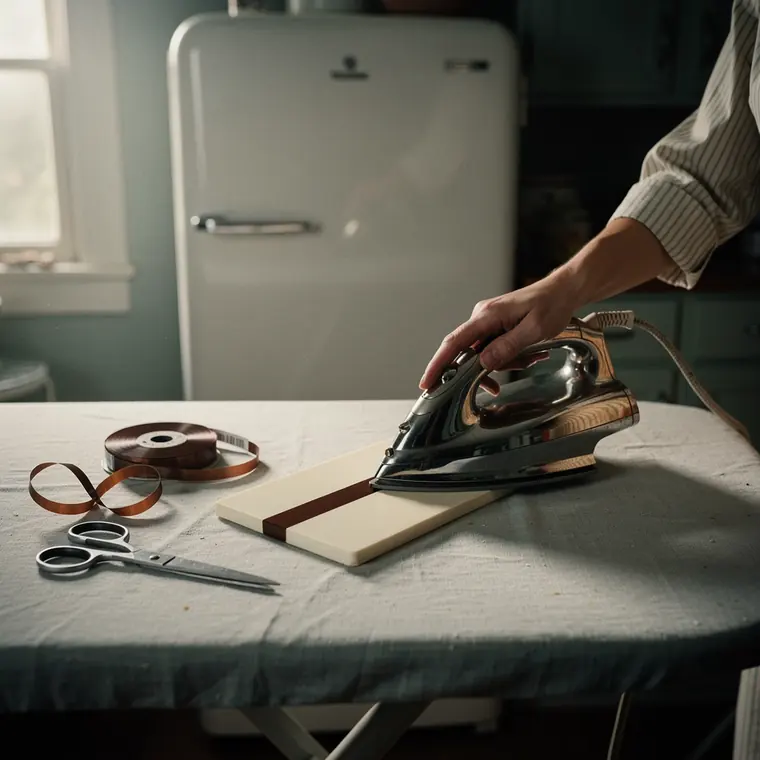
A first hand-made magnetic stripe sample of 1960 lying on an ironing board in the kitchen of a family house in the United States, a blank cream-white plastic rectangle eight and a half centimetres long and five and a half wide, along its full length a strip of matt brown magnetic recording tape one centimetre wide, the board covered in pale cotton, beside the rectangle a small open reel of brown tape, a pair of steel scissors and a chrome-plated electric iron with a cloth-covered cord, a woman's hand in a striped cotton sleeve just setting the iron down on the strip, behind it a white refrigerator, window light from the left.
- What it was used for
- The magnetic stripe carries the account number so that a device, not a person, reads it. Jerome Svigals, who took part in the development at IBM, gives the dimensions in IEEE Spectrum of 30 May 2012: card 5.4 by 8.6 centimetres, stripe 1 by 8.6 centimetres, carrying 3 tracks of 0.28 centimetres each — track one for airlines, track two for banks, the third for the savings and loan industry. On his account two things drove the work: the wide-body 747 and DC-10, whose handling demanded self-service, and the telephone authorisations that were choking credit card traffic. The Computer History Museum gives the purpose of IBM's Information Records Division in Dayton, New Jersey, as initially "government security use".
- What was new
- The Computer History Museum dates the prototype by IBM engineer Forrest Parry — a strip of recording tape attached to a plastic card with a clothes iron — to 1969. Svigals, himself a participant, gives 1967 in IEEE Spectrum as the trigger, describes the first prototype as a piece of cardboard with the stripe taped to it, and does not mention Parry. What mattered was what the solution could do: a stripe that can be applied to plastic in series. Svigals writes that developing a reliable high-speed strip-laying machine took more than 2 years and that the cost per card fell from 2 dollars to 5 cents by 1980. The barb: on his account IBM did the work for free and did not patent the card.
What the sources leave open: The Computer History Museum dates Parry's prototype to 1969, IBM itself to the early 1960s; Svigals describes 1967 as the starting situation, the first prototype as cardboard with taped-on stripe, and does not mention Parry.