The Address Reader
1965 · Optical Character Reader for Mail · Work 751 of 1,871
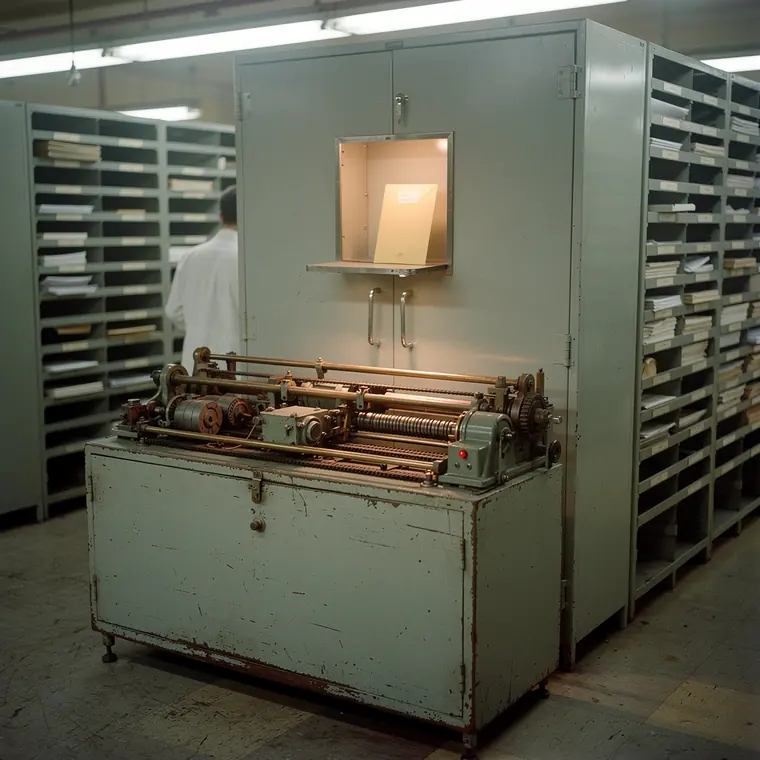
An optical scanning machine for envelopes of 1965 at the head of a long sorting frame in the main post office in Detroit in winter, a pale grey sheet-steel base cabinet one metre high and two metres long, on its top an open bed of small electric motors, rubber rollers and narrow belt tracks, behind it a tall pale grey cabinet with two flat doors, one single envelope standing upright in a narrow lamp-lit window, back side toward the lens, beyond it a grey steel frame of several hundred narrow pigeonholes with blank label frames, a technician seen from behind in a white coat, concrete floor, fluorescent light from above.
- What it was used for
- The address reader took the keying away from the sorter: it read the printed address optically, extracted the ZIP code and steered the pocket with it. By the postal service's own account the Department put a high-speed optical character reader into service in the Detroit post office in November 1965; the National Postal Museum dates the first run on live mail to 30 November 1965 and gives 36,000 ZIP-coded letters per hour. Coupled to a multiposition sorting machine, the reader sorted letters to one of 277 pockets, per the postal service. The Library of Congress quotes the 1965 annual report on a contract for 6 optical readers, each able to sort about 36,000 pieces per hour, developed by 3 firms.
- What was new
- What was new was that the machine read, instead of waiting for a person to read and key — the bottleneck of multiposition sorting fell away. The work behind it was old: the National Postal Museum gives 1954 as the start of development of the Farrington Automatic Address Reader and a contract with Farrington requiring at least 10,000 letters per hour, triple the rate of the semi-automatic machines then in testing. The barb is the precondition: the device could read only what the sender had written suitably. The Library of Congress dates the introduction of the ZIP Code to 1 July 1963 and quotes the 1963 annual report that widespread use of the code was expected to pave the way for mechanised scanning, and adds in its own words that scanners were not practical until ZIP Codes were firmly in use. The machine waited on the writing habits of millions.