The Tokyo Mail Sorter
1968 · Handwritten Postcode Reader and Sorter · Work 756 of 1,871
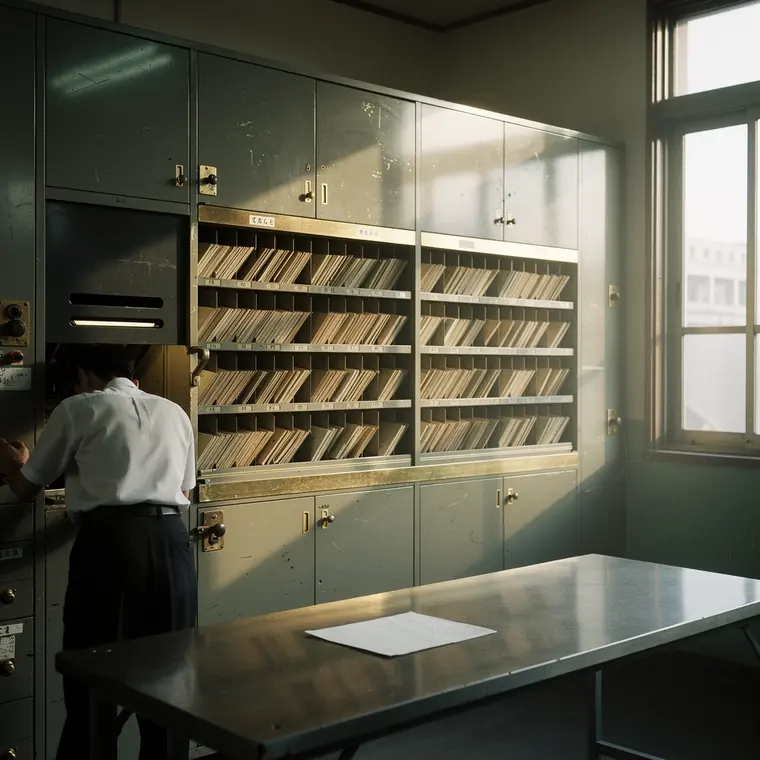
An automatic mail sorting machine of 1968 in a postal hall in Tokyo in summer, a wall of cabinets six metres long and two metres high, clad in plain grey panels of sheet metal, at the left end a narrow dark feeding cabinet with a slim intake slot, to the right five horizontal rows of twenty open pockets each, in every pocket pale envelopes standing slanted and seen edge-on, above each row a plain narrow metal strip, on a steel table in front one single envelope lying back side up, a postal worker seen from behind in a short-sleeved white shirt at the intake, daylight from tall steel-framed windows on the right.
- What it was used for
- The TR-3 and TR-4 sorting machines from Tokyo Shibaura Denki, today Toshiba, read handwritten postal codes. The Computer Museum of the Information Processing Society of Japan gives 1 July 1968 at the Tokyo Central Post Office as the day they were presented to the public — the same day the Japanese postal code system was inaugurated. The machines read 3 digits per item, written by the sender into pre-printed red boxes, and handled 20,000 items per hour. The TR-4 had 100 slots in 5 rows; the TR-3 had 52 in 4 rows.
- What was new
- What was new was handwriting. Readers for printed characters had been available since around 1950; the Japanese machines recognised, on the IPSJ Computer Museum's account, "ordinary handwritten numbers", and the museum calls them "the world's first practical mail sorters to recognize and sort mail items". The barb is in the envelope: for the machine to read, the post had to redesign the mail piece and the sender had to comply — only the pre-printed red boxes were readable, and they held 3 of the 5 digits. The same source dates NEC's NAS-5 to 1968 with evaluation at Omiya post office in October, and the commercial NAS-5B to June 1969 at Shinjuku post office.
What the sources leave open: The priority claim is made by the Computer Museum of the Information Processing Society of Japan; the sources give no independent confirmation. For the TR-3 the museum page gives 52 slots in 4 rows in one place and 50 in another.