The Giro Centre
1968 · Computerised Postal Giro Bank · Work 757 of 1,871
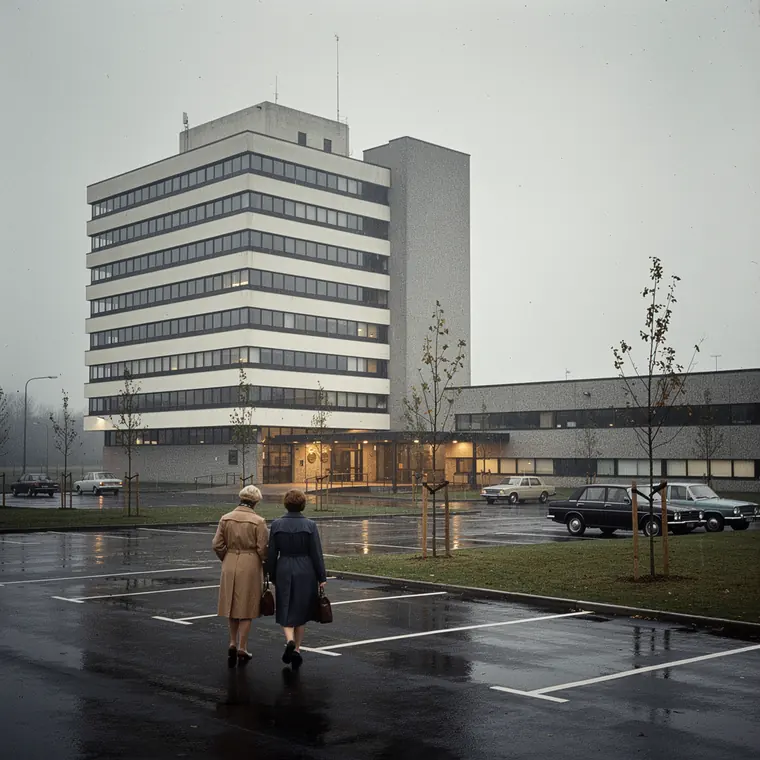
A new office tower of 1968 on flat open land at the edge of Bootle in north-west England on a rainy October morning, the tower ten storeys high with four wings set off against one another, its long fronts made of pale concrete floor bands alternating with continuous strips of dark windows, its narrow end walls of grey pebble-surfaced concrete, a plain concrete parapet at the roof, to the right a long low building with few windows, in front a freshly laid asphalt car park, wet, with few small saloon cars and young trees tied to stakes, two women seen from behind in raincoats walking toward the entrance, even grey overcast light.
- What it was used for
- The National Giro Centre at Bootle kept the accounts of the British Post Office's state giro, opened on 18 October 1968 by Prime Minister Harold Wilson; the Postmaster General responsible was Tony Benn. It was meant for people without a bank account: deposits, withdrawals and transfers went over the counters of 23,000 post offices, while the posting was done centrally. A promotional booklet projected about 1,200,000 customers within 1 or 2 years. The first 6 months brought 110,000 accounts, and the business then ran at a loss for 7 years; by the 1970 review the losses had reached over 19.7 million pounds. In 1972 the workforce was cut from 3,500 to 3,000.
- What was new
- The Postal Museum's catalogue description calls the institution the first bank in the world to be planned and built from its very beginning as a fully computerised unit. Alan Booth and Mark Billings, in their book chapter (Routledge 2011), place the Giro within the techno-nationalism of the Wilson governments: it was to run on computers from the outset and also to help the British computer industry against American competition. What began as an account for the unbanked grew, according to the Postal Museum, into Britain's sixth biggest bank, became an independent plc in 1988 and was sold to the Alliance and Leicester Building Society in 1990.
What the sources leave open: The priority as the first bank planned from the outset as a fully computerised unit rests only on the Postal Museum's catalogue description, which gives no further evidence.