The Document Processor
1973 · Magnetic Ink Document Reader-Sorter · Work 758 of 1,871
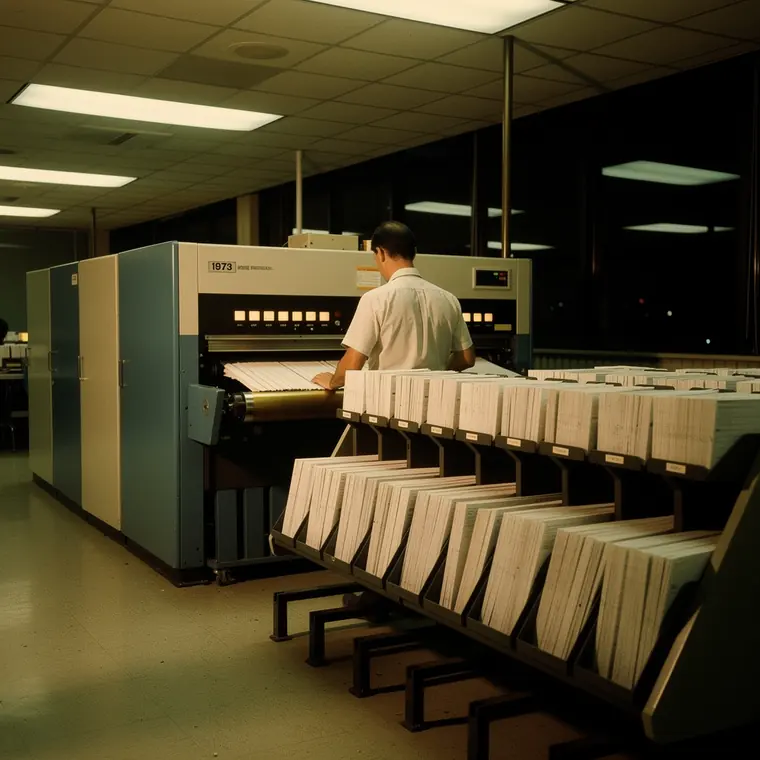
A high-speed document sorting machine of 1973 in the processing hall of a bank clearing centre in the United States at night, a train of cabinets eight metres long and one and a half metres high, at the left three closed cabinet sections in pale grey and blue sheet steel, in the middle a feed section with a dark strip of small lamps, at the right a row of thirty-six tall slanted sheet-metal pockets raised on dark set-back pedestals, in every pocket a block of white paper slips seen edge-on, an operator seen from behind in a short-sleeved shirt at the feed bay, black night windows, a grid ceiling with glowing light panels.
- What it was used for
- In the clearing centres of large banks a reader-sorter read and sorted the paper cheques: read the magnetic codeline along the bottom edge, endorse the item and drop it into pockets. The scale behind this shows in the US central bank's figures: the Federal Reserve's commercial cheque volume peaked in the early 1990s at just over 19 billion cheques a year, and was still 16.9 billion in 2001. Digital Check, itself a maker of such machines, dates the introduction of the IBM 3890 to the early 1970s and gives the top models of this class a rated speed exceeding 2,000 documents per minute. IBM's own corporate history records that in 1961, when the Pacific National Bank of Seattle installed one of the first IBM 1401 systems, its speed jumped from 3 to 75 cheques per minute.
- What was new
- Machines that read magnetic characters existed earlier - IBM's own history pages show a 1960 advertisement for IBM Magnetic Character Sensing Equipment. What is documented is the end: under the Check Clearing for the 21st Century Act, passed in 2003 and effective on 28 October 2004, an image was allowed to replace the paper cheque. The Federal Reserve still had 45 cheque processing centres in 2002, 22 operating in 2007, and in 2010 just 2 sites still processed cheques.
What the sources leave open: No reliable novelty can be stated from the sources available. They do not settle which machine in this class could do what first, and no rated speed for the machine could be found in a primary source (manual or announcement).