The Chip Ring
1974 · Microcircuit Ring and Hand-Wired Terminal · Work 759 of 1,871
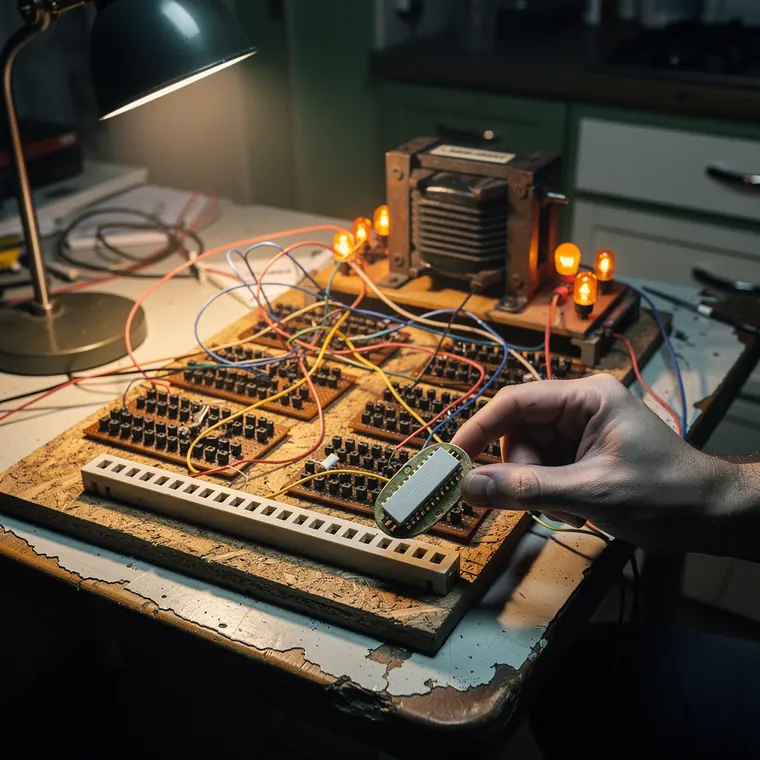
A hand-built electronic prototype of 1974 on a kitchen table in Paris in the evening, a raw chipboard panel fifty-three by thirty-seven centimetres, on it brown perforated circuit boards with rows of small black components under a loose tangle of thin red, blue and yellow wires, at the back a small transformer and five small glowing lamps, at the front edge a strip of socket contacts, a man's hand holding just above it a tarnished thin metal finger ring, on the ring an oval greenish setting carrying a white ceramic component three centimetres long with eight gilded legs along each long side, warm light from a jointed desk lamp on the left.
- What it was used for
- Roland Moreno wanted to use a memory chip worn like a signet ring to identify oneself at a reader. His first patent, filed on 25 March 1974, concerns - according to the caption in France Mémoire - a memory object in the form of a ring; the photo shows it in the reader built for it. heise reports that a chip was soldered onto the ring and its legs pressed into a socket, sealing it as with wax; heise calls the solution rather impractical, though a demonstration in 1976 succeeded. Moreno then moved to a card inserted in a reader. What went into use was not the ring but what came of it: from the beginning of 1983 the Télécarte in card telephones, whose first run of 250,000 sold out quickly according to heise, and in 1986 the first French chip bank cards, trialled in Brittany.
- What was new
- The ring was not the first idea of putting memory into a portable object. France Mémoire lists, before Moreno, patents by Pomeroy (1967, USA), Gröttrup and Dethloff (1968 in Austria, 1969 in Germany), Ellingboe (1970, USA), Arimura (1970, Japan), Castrucci (1971, USA) and Halpern (1972, USA); heise dates the Dethloff and Gröttrup filing to 6 February 1967. Moreno's own share lay less in the chip than in exploiting it: 45 patents between 1974 and 1979, and, according to heise, some 150 million euros from patents and Innovatron up to his death in 2012.
What the sources leave open: France Mémoire dates the Gröttrup and Dethloff patents to 1968 (Austria) and 1969 (Germany), heise their filing to 6 February 1967; neither source explains the difference or decides who was first.