Pontcysyllte Aqueduct
1805 · Cast Iron Trough Aqueduct · Work 76 of 1,871
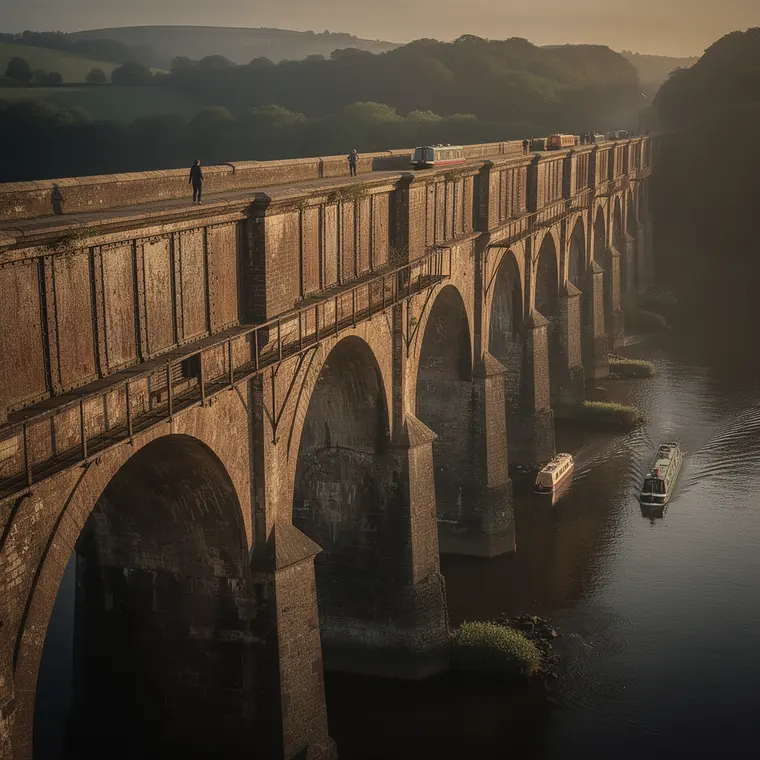
The Pontcysyllte Aqueduct carrying a cast iron trough on eighteen tapering masonry piers above the Dee, the towpath cantilevered over the water with narrowboats passing along it.
- What it was used for
- A canal bridge carrying the Ellesmere Canal across the valley of the Dee; first stone 25 July 1795, opened 26 November 1805. Barges about two metres wide with loads of some 30 tonnes crossed it: coal above all, also limestone, iron, slate and general goods. The canal never reached what it was built for. Neither Wrexham nor Shrewsbury was connected, and the aqueduct ended at a terminus branch. The Cadw list entry records the sting: by the time the change of plan came, construction was already too far advanced - otherwise Trevor would probably have been reached by cheaper tramroads instead. Commercial traffic had ceased by the Second World War. Today the structure carries some 15,000 boat movements a year and conveys drinking water.
- What was new
- Cadw explicitly calls it the third iron canal aqueduct in the world, but by far the most influential; Telford's aqueduct at Longdon-on-Tern was the test piece. The design driver was weight. To keep the original height of 38 metres, the masonry piers were made hollow in their upper parts and the spans built in cast iron rather than as embankment and masonry. The trough is made of plates two inches thick, bolted at external flanges; the joints were sealed with flannel, white lead and iron borings. The towpath sits above the water level so that displaced water can flow back underneath a passing boat.
Connections
Every connection names its kind. “Forerunner” on its own would be a claim.
- Follows fromIron Bridge1779English Heritage: because the Iron Bridge's massive strength let it survive the great flood of 1795, builders and engineers like Thomas Telford were motivated to construct their own iron structures. Work on Pontcysyllte began that same year; Telford's plans used a cast-iron trough to carry water and boats across the valley.Source: English Heritage: History of Iron Bridge · Institution of Civil Engineers: Pontcysyllte Aqueduct · UNESCO World Heritage Centre: Pontcysyllte Aqueduct and Canal (Ref. 1303)