Bruxelles-Tervueren
1897 · The Revolutionaries · Work 760 of 1,871
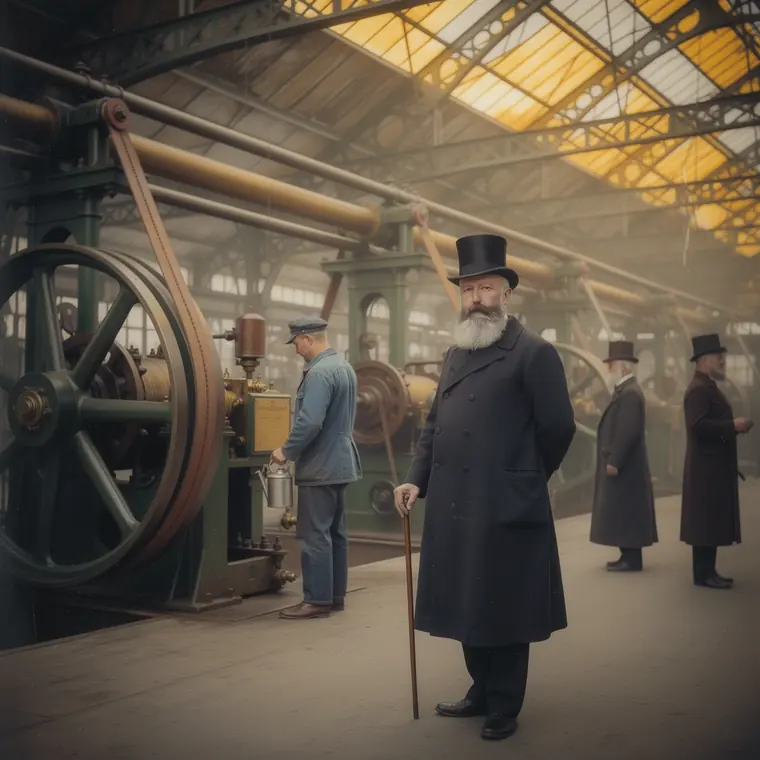
The scene filling the whole frame with the hall floor running to the bottom edge, a vast iron and glass exhibition hall in a Belgian city, afternoon of 31 July 1897, daylight through a glass roof on riveted cast-iron trusses, at the left edge of the frame the rim and spokes of a flywheel of several metres belonging to a horizontal blowing engine for a blast furnace, a long low steam engine on a cast-iron bedplate, wide flat leather belts running from the flywheel rim up to overhead shafting, two large dynamos beside it, at the engine's bearing a mechanic in a blue cotton work jacket and cap with an oil can, in profile, some steps further back two gentlemen in dark frock coats and top hats, one grey-bearded, one clean-shaven, seen from the side, and standing on the open floor in the centre of the frame directly beyond the flywheel, at the same distance from the camera as the mechanic, the man, a living figure in the scene and the only person whose face is sharp, a tall man of sixty-two with a long white full beard in a black top hat and long dark double-breasted frock coat, a walking stick in one hand, the other behind his back, his face turned toward the camera.
- Who
- Leopold II (1835–1909) was King of the Belgians from 1865 until his death, and at the same time ruler of a vast territory in Africa that belonged to him personally. In February 1885 the General Act of Berlin recognised his claim to the Congo basin, which became the "Congo Free State". Leopold never set foot in the Congo, but he governed and exploited it from Brussels, above all for ivory and rubber. People who failed to bring in enough rubber were punished savagely or killed, and women were taken hostage. In 1904 the British consul Roger Casement published a report on this violence, and the Congo Reform Association was founded the same year. In 1908 the Congo passed to the Belgian state. No one knows exactly how many people died: the American author Adam Hochschild put it as high as ten million in 1998; historians such as Jean Stengers considered that exaggerated, though they did not deny that the population fell sharply. In Brussels the king laid out grand avenues and buildings. In 2020 several of his statues were removed or damaged, and King Philippe expressed to the Congo his "deepest regrets" for the violence of the colonial era.
- The moment
- On the afternoon of Saturday 31 July 1897 the Lord Mayor of London and a large retinue visited the international exhibition in Brussels. The King had arrived before his guest. While the Englishman toured the Belgian section, Leopold spent his time in the machinery hall, as a Dutch newspaper reported three days later. The hall held machines by the best Belgian builders: Cockerill's blast-furnace blowing engine of more than 1,000 horsepower, an "iron belfry", along with horizontal steam engines, huge flywheels and dynamos supplying light and power to the hall. The exhibition had two sites, the Cinquantenaire park in Brussels and Tervuren with the Congo section. At the King's insistence a new avenue, 15 kilometres long and 80 metres wide, joined them; from May 1897 an electric tram made the trip in half an hour. The picture shows the King among the machines, aged 62, in a frock coat.
- The other side
- At the other end of that tram line, the same summer, 267 men, women and children from the Congo lived in three fenced villages, brought over under compulsion to advertise the King's Congo Free State. Seven of them died at Tervuren and were refused burial in the local cemetery. Leopold did not show himself to them, apparently out of concern for his prestige, as a Brussels correspondent wrote in August 1897. Since 1953 their graves have lain beside the church at Tervuren.
What the sources leave open: A Dutch newspaper reports that the King was in the machinery hall on 31 July 1897; which machine he stood before is not recorded. Blowing engine, flywheel and dynamos are documented inventory of the hall. His dress, his suite and the weather are not described. Belgian papers of the day were not consulted. The death toll in the Congo Free State remains disputed.
Further reading
Sources
- KB Delpher, niederländische Tageszeitung, 3.8.1897: 'De Lord-Mayor te Brussel' (König vor dem Gast eingetroffen, in der Maschinengalerie)
- KB Delpher, 29.7.1897: Reiseplan des Lord Mayor (Samstag Ausstellungsbesuch)
- KB Delpher, 2.8.1897: 'Gemengd Buitenland' (Empfang im Ehrensalon, halb drei)
- KB Delpher, 21.8.1897: 'Verspreide berichten' (sieben Kongolesen in Tervuren gestorben)
- KB Delpher, 22.8.1897: 'Faure's bezök' (Leopold zeigt sich den Kongolesen nicht)
- [Thomas Braun]: La vie moderne à l'Exposition internationale de Bruxelles 1897 (Galerie des Machines, Avenue de Tervüren 15 km / 80 m, Tram eine halbe Stunde)
- Musée du Transport Urbain Bruxellois: Historique (Tram nach Tervuren auf Wunsch des Königs, Mai 1897)
- AfricaMuseum Tervuren: The human zoo of Tervuren (1897)
- National Museum of Ireland: Casement in the Congo Free State (Ausstellungstafel)
- Hérodote.net: Léopold II (1835-1909), le roi géographe
- Mail & Guardian, 21.5.1999: The forgotten holocaust (Hochschild gegen Stengers zur Opferzahl)
- Africanews, 30.6.2020: Belgian king 'deeply regrets' colonial injustices in DR Congo
- Brussels Times, 12.6.2020: Belgium's Prince Laurent: 'Leopold II never went to Congo' (Denkmäler 2020)