The Wreck Astrolabe
1503 · Cast Mariner's Astrolabe · Work 762 of 1,871
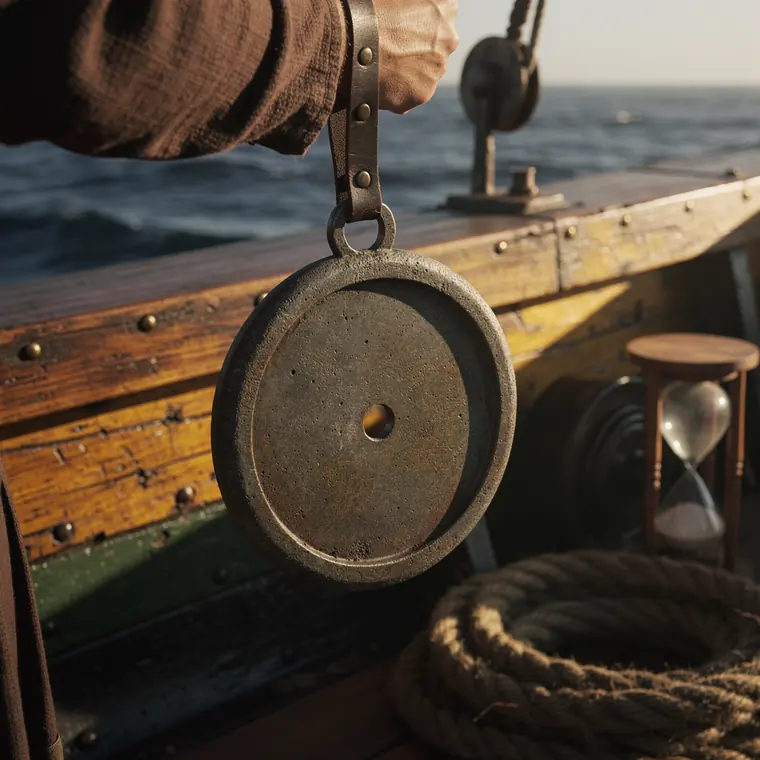
A cast metal disc of 1503 hanging from a leather strap on the afterdeck of a Portuguese ship in the Indian Ocean, the disc seventeen centimetres across, its surface grainy grey-brown with darker and paler patches, a small ring at its top for the strap, seen edge-on in profile and slightly from behind so that only the thick granular rim and a small hole at its centre catch the light, its front turned away in shadow toward the man holding the strap, his hand in a sleeve of coarse brown wool, behind him a bulwark of raw oak, coiled hemp rope, a sandglass, sun high from the right, dark blue water.
- What it was used for
- The mariner's astrolabe served to find latitude. The navigator let the disc hang vertically, sighted the Pole Star through the pinholes of the two vanes on the pivoting alidade or - held low, with the sunbeam passing from hole to hole - the Sun, and read the altitude above the horizon from the scale on the rim. According to Royal Museums Greenwich the instrument came into use in navigation by about 1470; Vasco da Gama carried one on the voyage around Africa to India in 1497 to 1499. The disc in question is of leaded gunmetal, 175 mm across and 344 g in weight, probably made between 1496 and 1501. It lay in the wreck of the Esmeralda, which was lost in 1503 off the Omani island of Al Hallaniyah together with her commander Vicente Sodré.
- What was new
- What is new about this disc is not its design but that it became legible at all. To the naked eye the find showed no scale, no proof that it was an astrolabe. A team from WMG at the University of Warwick scanned the piece in Muscat in November 2016 with a portable 7-axis laser scanner that collects over 50,000 points per second at 60 micron accuracy; in the 3D model 18 evenly spaced marks emerged on the limb, their spacing equal to 5 degrees. Only then could the piece be identified as a mariner's astrolabe. The priority concerns survival, not technology: Guinness World Records lists it as the oldest known mariner's astrolabe, while the type had already been carried at sea for decades before it was made.
What the sources leave open: The sources date the mariner's astrolabe's first use at sea differently: Royal Museums Greenwich gives about 1470, WMG and Sci.News a Portuguese voyage down the West African coast in 1481.
Further reading
- WMG, University of Warwick: Earliest known Mariner's Astrolabe research published today to go in Guinness Book of Records
- Royal Museums Greenwich: What is a mariner's astrolabe?
- Sci.News: World's Oldest Mariner's Astrolabe Found (with reference to Mearns et al., International Journal of Nautical Archaeology, 2019)