The Backstaff
1711 · Shadow Sighting Quadrant · Work 764 of 1,871
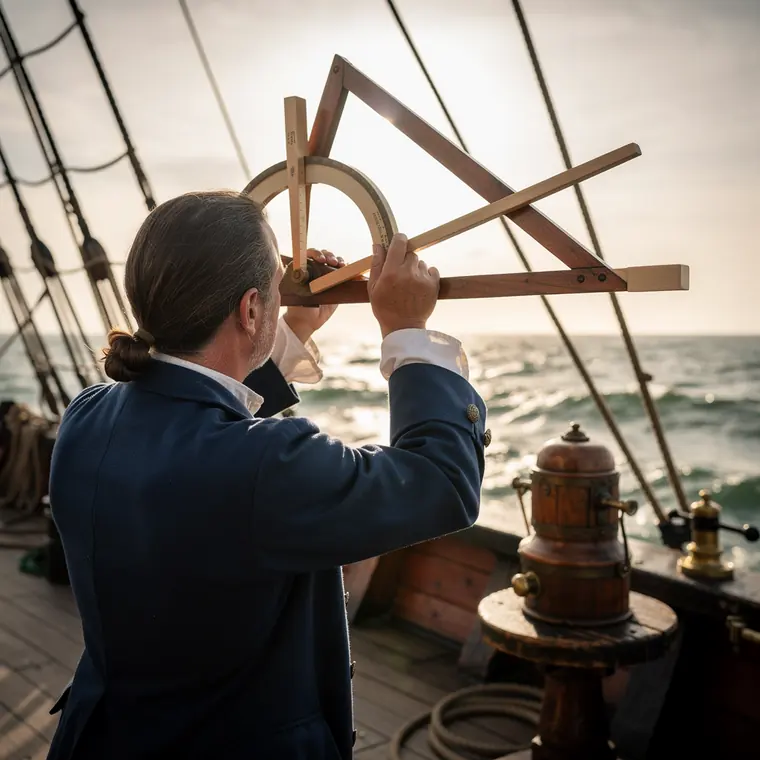
A wooden backstaff of 1711 held by a man on the afterdeck of a merchant ship, the man seen from behind in a blue wool jacket, the instrument a flat triangular frame of dark red-brown wood sixty centimetres long, a small arc at the far end with a pale boxwood slide raised over his shoulder toward the sun behind him, a larger arc near his eye with a second pale slide, a third pale block at the tip, two straight bars with a short cross brace, the arc edges catching the light as smooth pale rims, bulwark, tarred shrouds and a wooden binnacle beside him, hard sun from behind left, grey-green sea.
- What it was used for
- The backstaff, also called the Davis quadrant and in France le quartier anglais, served to measure the Sun's altitude at sea and thus to find latitude. The name states the method: the observer turned his back on the Sun instead of sighting towards it. Gerald Forty, in the Journal of Navigation (volume 39, issue 2, 1986, pages 259 to 268), describes it as the principal altitude-measuring instrument on board alongside the cross-staff, first described in its simplest form by John Davis in 1595 in The Seamans Secrets and only reaching its effective final form well into the 17th century.
- What was new
- Forty also uses backstaff as a generic term for all instruments in which the observer turns his back on the Sun, such as Gunter's bow, and traces them to the Davis quadrant, the commonest form in England and elsewhere. What could not be done before was to measure the Sun's altitude without looking into the Sun - the cross-staff required exactly that. The barb is at the end: when reflecting instruments arrived in the 18th century the backstaff did not disappear but stayed in use - in Forty's assessment because it was cheaper, but perhaps also partly because of the ingrained conservatism of seafarers. More than 150 years in service.
What the sources leave open: Forty dates the usable form only to ‚well into the 17th century‘ and derives all backstaffs from the Davis quadrant; the Mariners' Museum, by contrast, says seamen had already used the cross-staff backwards.