The Hadley Octant
1731 · Double Reflecting Octant · Work 765 of 1,871
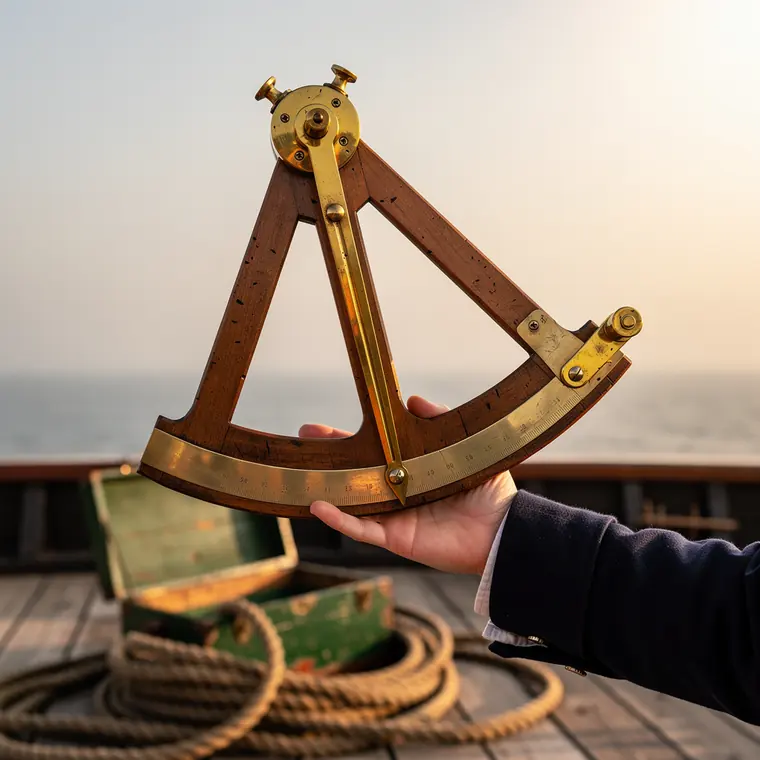
A wooden octant of 1770 held against the sky on the afterdeck of a merchant ship, a hand in a dark blue wool sleeve holding it, the instrument a triangular frame of dark brown mahogany nearly fifty centimetres tall, at its apex a round brass mount with two small brass fittings, a long slender brass index arm running from the apex down to the broad mahogany arc at the bottom, the pale cream ivory strip of the arc turned away from the lens in shadow, a brass clamp shoe at its right end, on the deck an open green-stained wooden box, tarred rope and a grey horizon, sunlight from the upper right.
- What it was used for
- The reflecting octant measured the altitude of the Sun or a star above the horizon, from which latitude followed. A small mirror throws the star's light onto a half-silvered mirror; through its transparent half the observer sees the horizon and adjusts the star mirror until image and horizon meet - the scale on the mirror arm gives the angle. How this worked on board is shown by the first sea trial of the American instrument developed at the same time: the sloop Trueman left Philadelphia on 28 November 1730 for the West Indies and returned on 19 February 1731; Captain John Cox and the mate George Steward took solar, stellar and lunar-distance observations and found the readings, as far as they could judge, very exact, according to H. D. McGuire's account.
- What was new
- Hadley's description appeared in the Philosophical Transactions under the date 13 May 1731. In Philadelphia, Thomas Godfrey had worked out the same double-reflection principle independently in the spring of 1730 and disclosed it to James Logan in late May or early June 1730. Hadley's printed account preceded Logan's letter to Halley of 25 May 1732 by more than a year; for McGuire, however, the date of invention decides priority, and that favours Godfrey. The glory and the profit still went to Hadley. H. D. McGuire records in Proceedings of August 1940 that, as far as can be determined, Godfrey was never rewarded by the Royal Society; he thus doubts the widespread story of a gift of furniture worth 200 pounds instead of money. And neither man was first: among Halley's papers, found after his death in 1742, was Newton's own handwritten description of a double-reflection instrument, which McGuire dates at least 15 years before either claim.