Berthoud's Marine Clock
1760 · Spring Suspended Marine Clock · Work 766 of 1,871
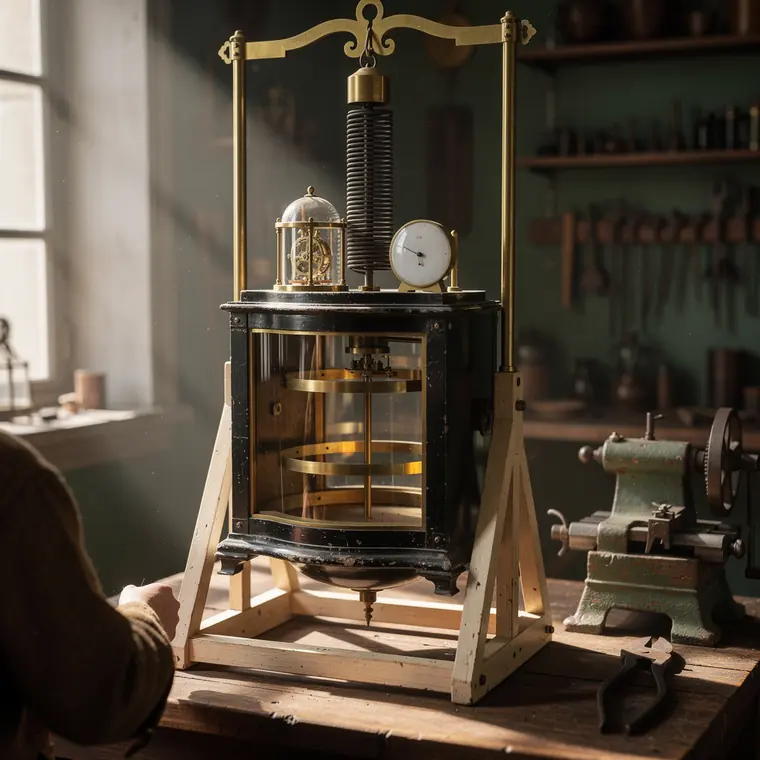
A large marine clock of 1761 hanging in a stand of pale wood with slanting struts in a clockmaker's workshop in Paris, the clock a black lacquered wooden case sixty-five centimetres wide with brass edges, the case and its bracket together about a metre high, hung from two straight brass rails meeting above in a bracket under a tall coil spring of dark steel, in the glazed front of the case two horizontal brass rings, on the top plate a small glazed brass cage and a small white enamel disc turned away from the lens, beside it a lathe and pliers, window light from the left, a sleeve of brown wool.
- What it was used for
- A clock that keeps the time of its port of departure while at sea gives the navigator his longitude. Ferdinand Berthoud's Horloge marine no. 1 of 1760 was meant to do this: it hangs in a gimbal suspension that keeps it upright when the ship heels, has a spiral spring and a compensation grid of brass and steel to absorb the thermal expansion of the spring. The Musée des Arts et Métiers in Paris, which has held the piece since 1814, places the work in the Anglo-French rivalry over mastery at sea: accurate clocks promised to solve the longitude problem and to shorten voyages.
- What was new
- No. 1 shows how far a spiral spring and grid compensation could be taken in 1760. The barb is in the dimensions: the object alone measures 103.5 x 64.5 x 64.5 cm, and 151 cm high with its stand - a ship's clock which, on the museum's account, was too large, and which led Berthoud afterwards to work at making them lighter and smaller. In that he got far: for the period from 1768 the museum gives his marine clocks an error of about 1 minute over a 3-month sea crossing, and no. 8 of 1767 sailed with Yves Joseph de Kerguelen de Trémarec to the Terres Australes in 1773 to 1774.
What the sources leave open: The museum sources make no priority claim for no. 1 and do not say who first used gimbals or the compensation grid; the object file credits such compensation systems to ‚the mechanicians‘ in general.