The Nautical Almanac
1767 · Lunar Distance Ephemeris · Work 767 of 1,871
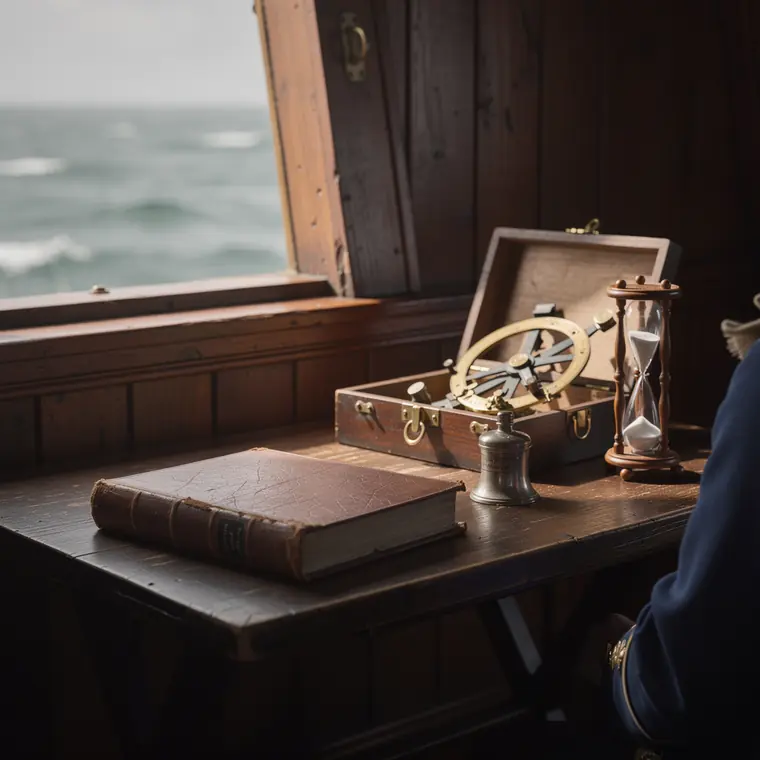
A small thick closed volume lying flat on a folding table of dark wood in the captain's cabin of a naval ship at sea, seen from a low angle along the table so that its cover is a plain strip of worn brown leather and its spine lies hidden against the wall side of the table, beside it an octant of dark wood and brass lying in its open wooden case with its arc turned away and hidden by the lid, a sandglass in a wooden stand and a small pewter inkwell, the table set against the panelled wall under a stern window, daylight through the stern window from the left over dark water, a sleeve of blue cloth at the edge of the frame.
- What it was used for
- The Nautical Almanac supplied the navigator with astronomical data in advance so that he could determine his longitude from lunar distances: the Moon's longitude, latitude, right ascension, declination, semidiameter and parallax, for noon and for midnight. Nevil Maskelyne proposed the work to the Board of Longitude on 9 February 1765; on 28 May 1765 the Board instructed him and the Professors to draw up a plan, which was ready in 2 days, and Parliament approved it. The first edition, for the year 1767, appeared in 1766 in about 2,000 copies at a price of 2 shillings 6 pence. Maskelyne also issued the Tables Requisite; its 1781 edition is said, as HM Nautical Almanac Office relates, to have sold 10,000 copies immediately on publication.
- What was new
- What mattered was not the lunar distance but the operation behind it. Every entry was computed independently by 2 people and compared by a third, except the Moon's data, which one person computed for noon and another for midnight, checked by differences - for the Moon's longitude to the 4th order. Under Maskelyne's superintendence 4 computers did more than half the calculations and about 24 others the rest; 10 comparers checked the work and read proofs, Malachy Hitchins alone doing three quarters of the comparisons. The barb lies in computing ahead: when the computers were about 10 years ahead, the Board stopped the work. Mary Edwards, who had already been doing her husband John's computations in his lifetime, had to ask for compensation for the lost income - and received it.