Thames Tunnel
1843 · Shield Tunnelling with Brick Vault · Work 77 of 1,871
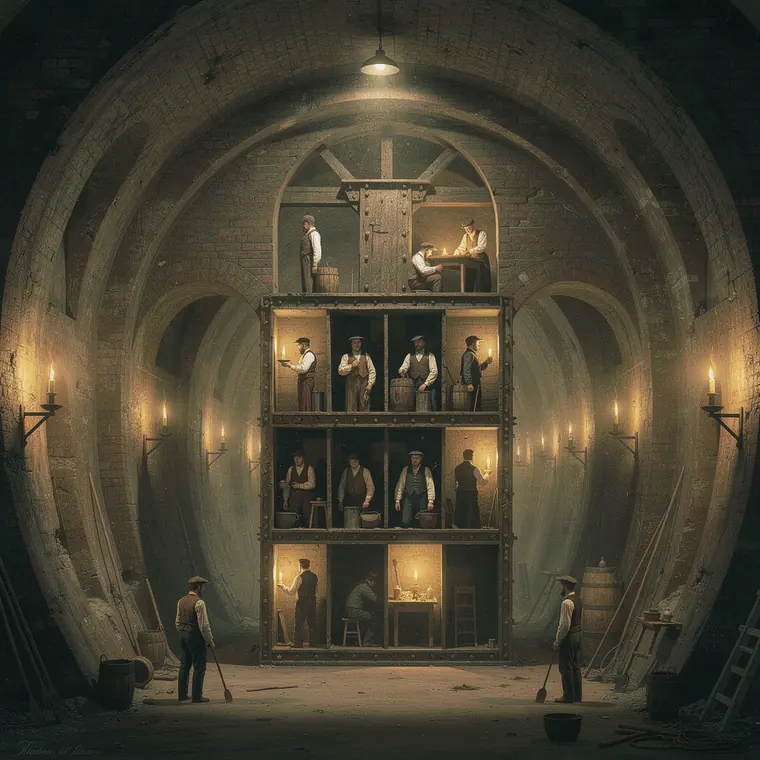
The Thames Tunnel at Rotherhithe, twin horseshoe passages of brick joined by an arcade of connecting arches, miners working in the cells of Brunel's rectangular shield at the face, the shield a stack of iron frames divided into three storeys of small cells with one man in each, the men in shirtsleeves, waistcoats and cloth caps or bare-headed, the workings lit by candles and oil lamps and the finished passages by gas jets on the walls.
- What it was used for
- The plan was a carriage tunnel for goods traffic between Rotherhithe and Wapping. The forty-foot spiral approach roads down which horse-drawn traffic was to have descended were never built. So the tunnel opened on 25 March 1843 as a pedestrian walkway at a penny a head: 10,000 people in the first 24 hours, a million within a few months. Stalls set up in the alcoves, kept mainly by women, and an annual fancy fair was held below the river; by the late 1850s the tunnel had a reputation as a haunt of tramps and drunkards. In 1865 the company sold it to the East London Railway for £200,000 - it had cost £634,000 to build. Trains have run through it since December 1869, today the London Overground's Windrush line.
- What was new
- It had failed twice before: in 1807-08 Trevithick got within a short distance of the north bank with timbered support and was drowned out by quicksand; in 1808 the experts called in declared a tunnel under the Thames unbuildable, and in 1809 the company was wound up. Marc Brunel's shield, patent no. 4204 of January 1818, reversed the order of work. An iron frame with 36 cells in twelve frames on three levels held the face while one man dug in each cell; after each advance the shield was forced forward and the brickwork went in immediately behind it. The ground was never left unsupported for more than a few inches. The tunnel took 18 years, seven of them walled up for lack of money, and on 12 January 1828 it cost six workmen their lives.
Further reading
- Transport for London, Research Guide No. 25: The Thames Tunnel
- Brunel Museum: Four views of the Tunnelling Shield (Patent Nr. 4204)
- Brunel Museum: The 1828 Tunnel Flood (Namen der sechs Toten)
- London Transport Museum: A brief history of the Thames Tunnel and the East London line
- Science Museum Group Collection: Thames Archway Company