The Beagle Chronometers
1831 · Boxed Marine Chronometers · Work 771 of 1,871
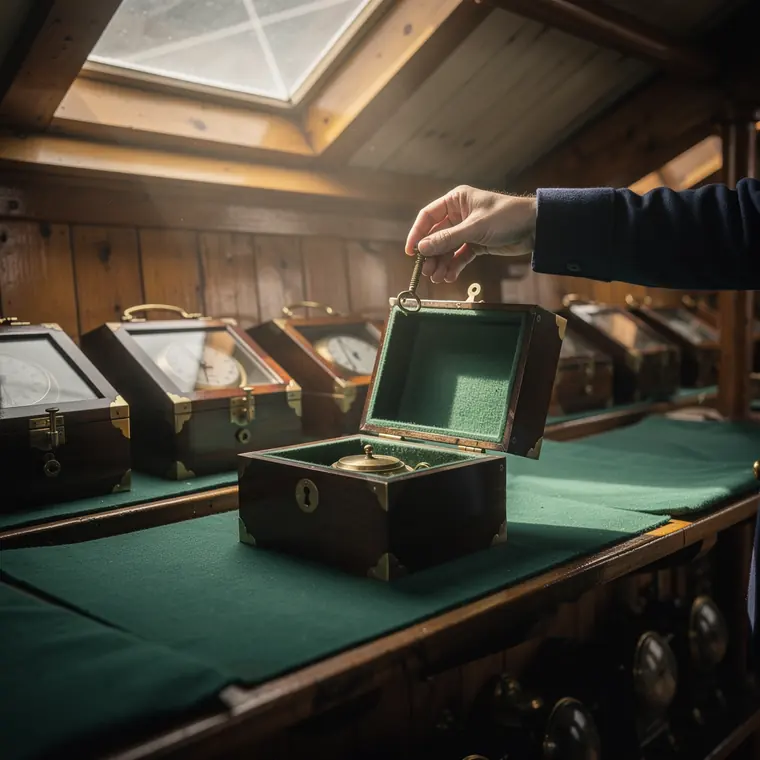
A row of chronometer boxes of 1832 on padded shelves in the chronometer room of a survey ship, a dozen square boxes of very dark brown mahogany, each nineteen centimetres square and twelve high, brass angles on the corners and a brass keyhole at the front, their glazed lids catching the window light so that the insides show only as bright reflections of the ceiling, the nearest box standing open, the inside of its lid plain green cloth, a hand in a dark blue woollen sleeve holding a small winding key above it, green baize on the shelves, varnished plank walls, light from a glass prism in the deck above.
- What it was used for
- The second voyage of HMS Beagle, from 1831 to 1836, set out to survey the coasts of South America; the Beagle chronometers were the timekeepers used on it to determine longitude. Captain Robert FitzRoy took 22 chronometers and designated one of them, K, as the observation chronometer. Claire Jowitt, Chair of the Society for Nautical Research, says of them that these chronometers established for the first time a linked chain of reference points of known longitude around the globe. Darwin wrote of an important error in the longitude of South America, whose settlement was the occasion of the voyage.
- What was new
- Carrying several timekeepers was not new: on Cook's second voyage William Wales already tested K1 alongside 3 timekeepers by John Arnold, divided between 2 ships. The Beagle carried 22. On coming home FitzRoy reported an error of 33 seconds in the chronometric calculations, and of the 22 watches only 11 were still fully going; Darwin noted on the voyage that at least 16 were going superbly. Of the voyage's pocket chronometers only 2 survive today. K was acquired for the National Maritime Museum through a fundraising campaign after an export bar in 2025 and is to go on display in October 2026. Greenwich became the Prime Meridian only in 1884.