The Chronoscope
1848 · Electromagnetic Interval Timer · Work 773 of 1,871
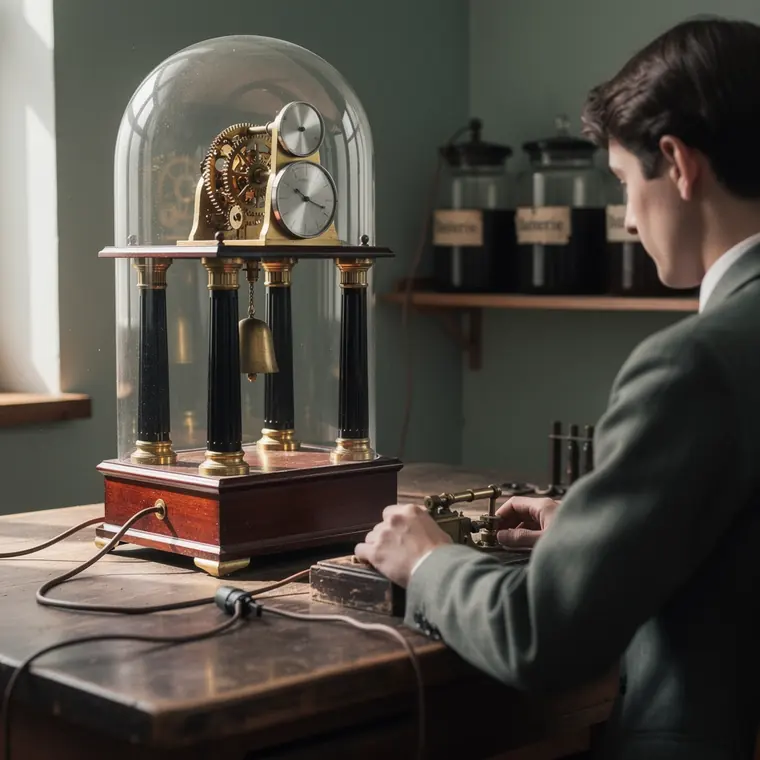
An electric chronoscope on a heavy wooden table in a university laboratory in Leipzig in 1880, sixty centimetres high, built as a small temple, a dark reddish brown wooden base, four black columns with brass capitals carrying an upper plate, on it the brass wheelwork and two small round silvered dials one above the other, seen at a slant and soft in focus, under a tall glass dome, a brass weight hanging on a cord between the columns, a brass telegraph key in front, cloth-covered wires to glass battery jars on a shelf, a young man seen from behind with his hand on the key, pale daylight from the left.
- What it was used for
- An electromagnetic short-interval timer. A clockwork runs continuously; an electromagnet engages the dial train and a spring disengages it, so that only the interval between two current pulses is counted. Its first home was physics and ballistics: according to the Max Planck Institute for the History of Science, Wilhelm Oelschläger proposed it for falling bodies and for trials measuring projectile velocity, and in spring 1849 a Hipp chronoscope was delivered to the Physical Institute at Utrecht University. Only later did it reach the psychological laboratories to measure reaction times - Wundt recommended it in 1874 in the first edition of his "Grundzüge der physiologischen Psychologie". On model 75 the dials read 1/10 and 1/1000 of a second.
- What was new
- Not the first short-interval timer: Charles Wheatstone had comparable devices earlier, and according to the MPIWG essay Oelschläger's 1848 article quoted incorrect results of short time measurements with Wheatstone's chronoscope - the instrument Hipp improved. According to the essay, Hipp's main improvement was separating the clockwork from the dial train: the clockwork first reached a steady speed, then the electromagnet engaged the hands. It was regulated (as described for model 75) by a steel lamella fixed at one end, vibrating 1000 times a second, governing the clockwork through an escape wheel with 20 teeth, its pitch checkable against a tuning fork. The barb: Hipp claimed the 500th part of a second, yet it came with a drop apparatus that served to calibrate and control it.