The Motor Clock
1852 · Electric Master Clock · Work 775 of 1,871
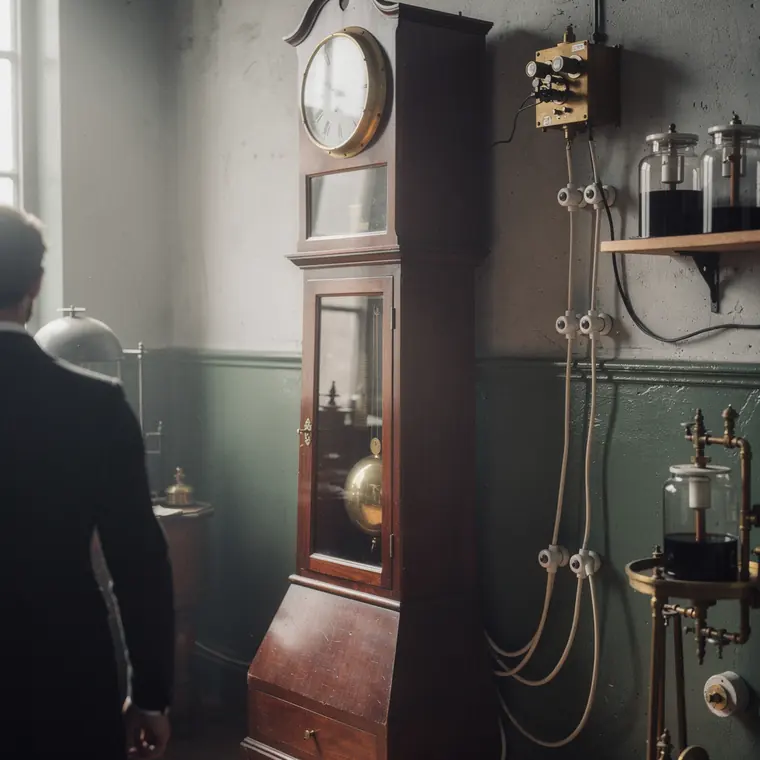
An electric master clock against the wall of a workroom in the observatory at Greenwich in 1853, a slender longcase one metre ninety high of dark reddish mahogany, its base curving outward toward the floor, in the hood two round pale dials one above the other, seen from the side at a steep slant and soft in focus, below them a tall glazed door showing the pendulum with its bright bob, from the case cloth-covered wires running on white porcelain insulators up the wall to a brass telegraph relay on a shelf, glass battery jars beside it, an astronomer in a dark frock coat seen from behind, north light from the left.
- What it was used for
- The electric master clock that Charles Shepherd of 51 Leadenhall Street, London, installed at the Royal Observatory Greenwich in 1852. Royal Museums Greenwich calls it the Shepherd motor clock: it sent regular galvanic impulses to several dependent dials in the building and held them in step. The frame of the public Gate Clock went into the wall on 20 May 1852 and the clock came into use on Friday 13 August; it cost 75 pounds and carries an unusual 24-hour dial, which at first showed astronomical time reckoned from noon to noon. Airy had seen Shepherd's system at the Great Exhibition in 1851 and ordered one in December 1851.
- What was new
- Not the first electric clock and not the first master-and-slave system: Shepherd had patented his design in 1849, and Royal Museums Greenwich calls the Great Exhibition installation of 1851 one of the world's first sympathetic clock systems. What was new was what hung on it at Greenwich: the Observatory's time now went out by telegraph. By 1853 the master clock drove the Gate Clock, 3 further clocks in the building and a clock at London Bridge station, and sent daily signals along the main lines. The barb: the distribution outlived the apparatus. In 1893 Dent No. 2012 replaced the Shepherd master clock, and the Gate Clock whose 24-hour dial visitors photograph has since 1991 been run by controllers based on the MSF radio signal.
Connections
Every connection names its kind. “Forerunner” on its own would be a claim.
- Follows fromCrystal Palace1851Shepherd installed a connected electric clock system at the Great Exhibition in the Crystal Palace in 1851. Airy recognised its potential and ordered one to be made for the Royal Observatory at Greenwich; it was supplied the following year.Source: Royal Museums Greenwich, Collections: Electrical motor clock, Charles Shepherd, um 1852