The Iron Spheres
1876 · Compensated Magnetic Compass · Work 777 of 1,871
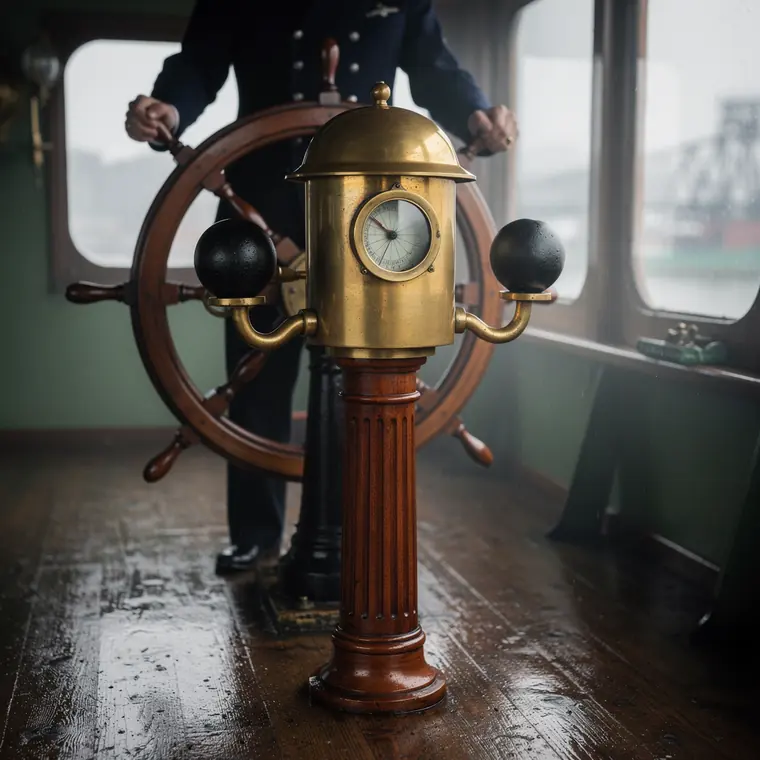
A ship's binnacle of 1876 before the wooden steering wheel on the bridge of an iron steamer on the river Clyde in 1878, a slender fluted pedestal of gleaming red-brown mahogany one metre high, on it a cylindrical head of polished brass with a domed hood and a round glass on top seen from the side so the card beneath shows only as a pale disc, on curved brass brackets to the left and right two matt black iron balls twenty centimetres across, two hands in dark blue uniform sleeves on the wheel behind it, wet deck planks, grey daylight through the bridge windows on the right.
- What it was used for
- Two soft-iron spheres on the arms of a binnacle, one each side of the card. They belong to the compass and binnacle that Sir William Thomson, later Lord Kelvin, patented in 1876 - Royal Museums Greenwich gives patent no. 1339. The problem: as ships were built of iron, the hull pulled the needles away from magnetic north in unpredictable ways. The spheres cancelled the quadrantal part of that deviation; corrector magnets, improved gimbals and a light card with small needles, less prone to oscillation and wear, came with it. An example in the Science Museum lists the errors the correctors address - quadrantal, semicircular and heeling - patented by William Thomson and made by James White, Glasgow, 1876 to 1879.
- What was new
- "The first compass correction" would be wrong. According to Dead Reckonings, Matthew Flinders found the vertical bar that bears his name around 1800, George Airy began swinging the ship and compensating deviation with permanent magnets and soft-iron chains - his methods did not work everywhere - and Archibald Smith started on the equations in 1843. What was new in Thomson's design was the consolidation: a housing that gave each class of error its own counterpart, and a light card. That small needles did better than the long ones favoured for centuries had, according to Dead Reckonings, already been found by Evans and Smith. The barb: the dry card, built against oscillation, later lost out, by the same account, to the liquid-filled compasses.
Further reading
- Compass and binnacle patented 1876 (patent no. 1339) by Sir William Thomson - Royal Museums Greenwich Images
- Binnacle with correctors for quadrantal semicircular and heeling errors - Science Museum Group Collection
- Magnetic Deviation: Comprehension, Compensation and Computation (Part I) - Dead Reckonings