The Cherub Log
1878 · Taffrail Distance Log · Work 778 of 1,871
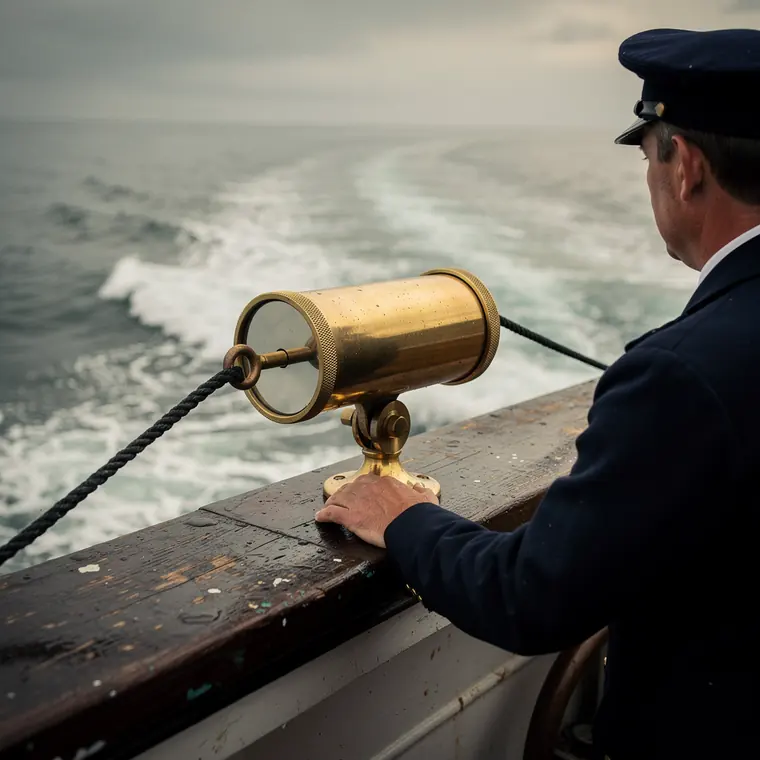
A towed ship's log of 1878 on the wooden taffrail at the stern of a steamer, a brass cylinder nine centimetres across and twelve long on a cast brass foot with a swivel joint screwed to the rail, seen exactly in profile so its thick knurled front bezel shows only as a narrow bright rim, its pale face turned fully away from the lens, from its rear end a brass shaft with an eye, from the eye a braided wet line running over the rail into the foaming wake, a sailor in a dark blue jacket seen from behind with one hand on the cylinder, grey sea light from an overcast sky.
- What it was used for
- A patent log by Thomas Walker & Son of Birmingham: a rotator, the "fish", runs in the wake behind the ship, and a long line carries its revolutions to a register on the stern rail, the taffrail. What it measured was distance run in nautical miles and, from that, speed - the quantities dead reckoning is worked from. Edward Massey's predecessor, invented in 1802, carried its register with it in the water: 3 wheels for fractions, units and tens, a capacity of 100 miles, and it had to be hauled in to be read. The Walker taffrail log, according to the Shipwreck Centre & Maritime Museum, did not.
- What was new
- What was new was where the register sat, not the measuring principle. The 1922 obituary of Thomas Ferdinand Walker, reproduced by Grace's Guide, names him as the man who produced the "Cherub" log, in which the rotator is in the water and the register placed on the taffrail, and calls that the modern form of ship's log. The dating is disputed: Grace's Guide records an 1878 patent by T. F. Walker alone for improvements in apparatus for ascertaining the speed of vessels, but does not link it to the Cherub; the Shipwreck Centre dates the introduction to the 1880s; Victorian Collections attributes the Cherub to a patent of 1897. The barb: the successor arrived in 1902, the Walker electric log, readable from several parts of the ship including the bridge - and the towed Cherub kept being built; the London Museum dates manufacture of the Cherub Mark II to about 1900 to 1930.