The Belville Arnold
1892 · Carried Time Distribution · Work 779 of 1,871
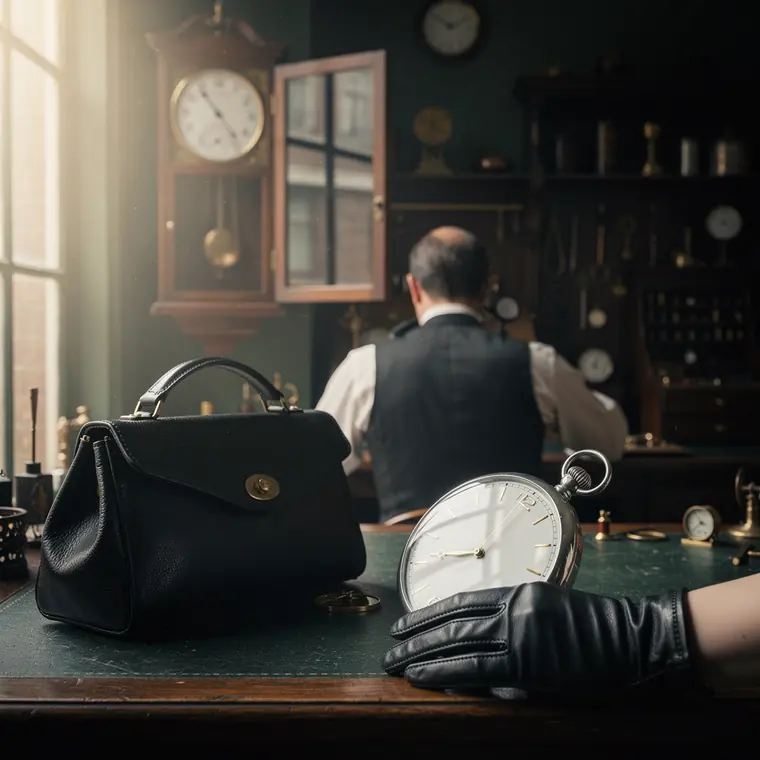
A silver pocket watch of 1892 on the dark wooden counter of a watchmaker's shop in London, an open-faced watch five and a half centimetres across with a smooth plain silver case and a large round bow, its white enamel face tilted at a steep slant and soft in focus, two slender gold spade hands, beside it a tall wall regulator with its glazed door standing open, an open black leather handbag, a woman's hand in a black kid glove resting beside the watch, the watchmaker seen from behind in a dark waistcoat with a loupe to his eye, daylight from the shop window on the left.
- What it was used for
- A pocket chronometer by John Arnold with which one family carried Greenwich time around London. John Henry Belville, Second Assistant at the Royal Observatory, was visiting watchmakers with it by 1840 according to the Royal Observatory Greenwich account; after his death in 1856 his widow Maria was allowed to continue, as she was not eligible for a widow's pension, and in 1892, when Maria grew too old, her daughter Ruth, 1854 to 1943, took over. In 1908 Ruth described her round: reset the watch at the Observatory on Mondays, then call on the customers, at least once a fortnight. Some 40 customers in the London area, for a small fee.
- What was new
- Nothing about this object was new, and that is the finding. The Linda Hall Library gives the watch as made by Arnold in 1794; in 1892 it was nearly 100 years old, and the method - set a good watch at the observatory and carry it to the customers - was the method London watchmakers were already using before 1835 to fetch the time from the Observatory. What it could do was the one thing that mattered: hold its rate between two visits; the Linda Hall Library reports that it was said to be accurate to a tenth of a second and writes that the watch ran for the Belville family for 104 years. The designation is disputed: Royal Observatory Greenwich lists the piece as "Arnold-345", originally made for the Duke of Sussex, while the Linda Hall Library calls it Arnold 485/786. The barb: the Observatory had distributed time by wire since 1852, the rhythmic time signals began on 19 December 1927 - and Ruth kept going into her eighties; Royal Observatory Greenwich puts the end probably in the autumn of 1940.
What the sources leave open: Royal Observatory Greenwich does not give the amount of the fee. The sources differ on the weekday the watch was set: Royal Observatory Greenwich, from Ruth's 1908 interview, gives Monday, the Linda Hall Library Tuesday.