Sheerness Boat Store
1860 · Rolled Iron Frame Construction · Work 78 of 1,871
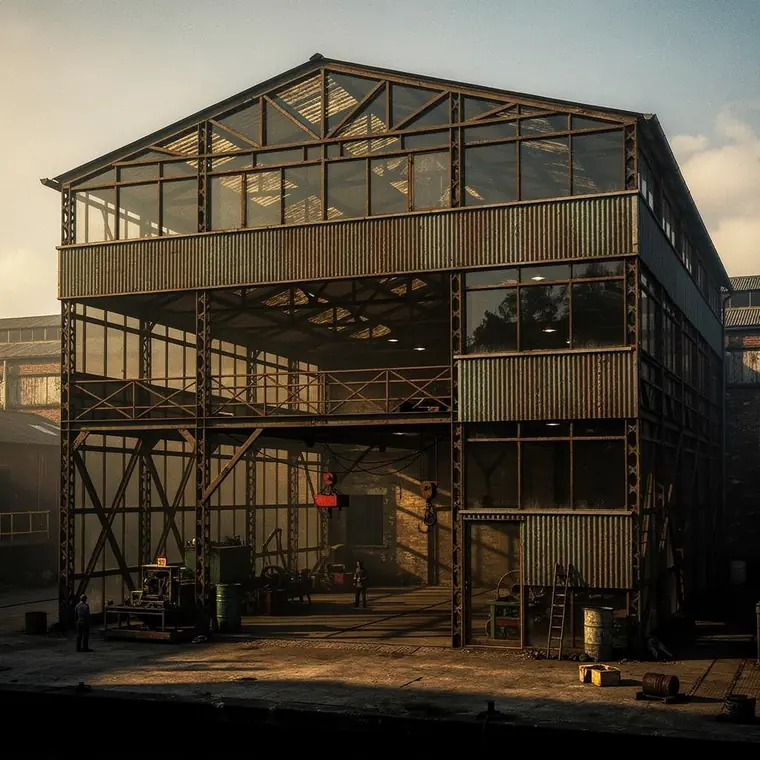
The Boat Store at Sheerness dockyard, four storeys of standard rolled iron sections forming an exposed frame, glazed and corrugated panels filling the bays, a travelling crane inside.
- What it was used for
- A boat store for the Royal Navy in Sheerness dockyard, built for the Admiralty Works Department under Colonel G. T. Greene. Four storeys, 14 by 9 bays, an open central aisle three bays wide with storage bays to either side. On each floor three travelling platforms ran on rails, moving boats the length of the building and between floors: not a shed but a machine for storing boats. The dockyard closed on 31 March 1960, with the loss of over 2,500 jobs. The building has stood empty since. It has been listed since 1962, today at Grade I, and is on Historic England's Heritage at Risk register: condition "very bad".
- What was new
- Historic England calls it the first structure to depend for its stability entirely on the rigidity of its joints; the Kent historic environment record puts it more cautiously as the earliest surviving example of a multi-storey iron-frame and panel-filling structure. Both mean the same thing: portal frames of cast-iron H-columns and I-joists with riveted wrought-iron longitudinal beams, and a skin of corrugated iron and timber panels that carries nothing. That is the difference from the iron-framed mills such as Ditherington, where the masonry carries part of the load. Skempton dates the building from the drawings, the column plaques and the final account to 1858-60; the list entry says 1856-60.