The Single-Gyro Compass
1908 · Gyroscopic Ship Compass · Work 780 of 1,871
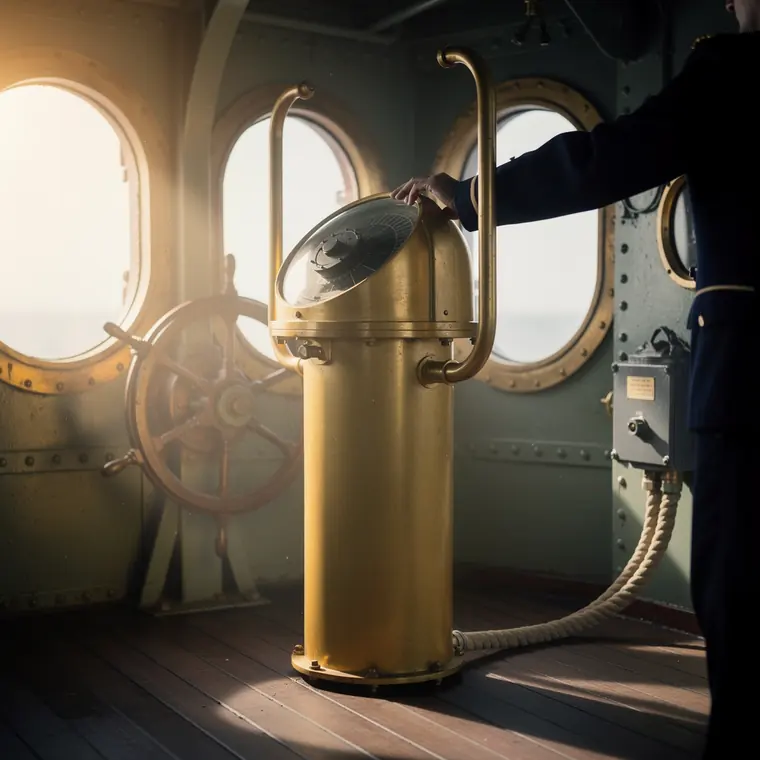
A gyroscopic compass of 1908 in its binnacle on the bridge of a warship at Kiel, an upright cylinder of matt yellowish brass one metre forty-six high, smooth plain sides, on top a round head with a dark disc under glass, seen from the side at a low slant so the disc shows only as a dark oval, two curved brass tubes rising left and right of the head, a thick cloth-wrapped cable running from its foot to a grey converter box on the wall, a hand in a dark blue uniform sleeve on the head, the steering wheel behind it, riveted walls, round windows with Baltic morning light from the left.
- What it was used for
- A north-seeking gyrocompass for ships whose steel hulls had made the magnetic compass unreliable. The Franklin Institute case file puts the problem this way: the metal of the new kind of ship shielded the compass from the earth's lines of force, the false field could not be told apart from the earth's, and the errors grew more serious with every gun added. The gyro instead settles mechanically. Hermann Anschütz-Kaempfe tested his devices in Kiel Fjord, according to the company's own history aboard the ship "Undine": stable against vibration, badly disturbed by waves on the outer fjord. The barb: 5 years passed between the shipboard-usable device presented in 1908 and the first merchant ship with an Anschütz compass - in 1913 HAPAG's "Imperator", 52,000 tonnes.
- What was new
- Two inventors in the same year, and the priority was contested enough for a formal objection. Sperry Marine records for 1908 the British patent no. 10382/08 of Anschütz for the first north-seeking gyrocompass, and for the same year Sperry's ballistic gyrocompass with vertical damping - and states that both 1908 devices were single-pendulum types. The Franklin Institute writes that the inventor was not Sperry but Anschütz-Kaempfe; that the successful trials of 1908 drew Sperry's attention; that Anschütz's company challenged Sperry's originality in 1914; and that Anschütz held US patents before Sperry did.
What the sources leave open: The Anschütz company history gives 1908 in its text for the first gyrocompass usable on board, and 1907 in the timeline on the same page for the first in operation.