The Earth Inductor Compass
1927 · Earth Inductor Heading Indicator · Work 785 of 1,871
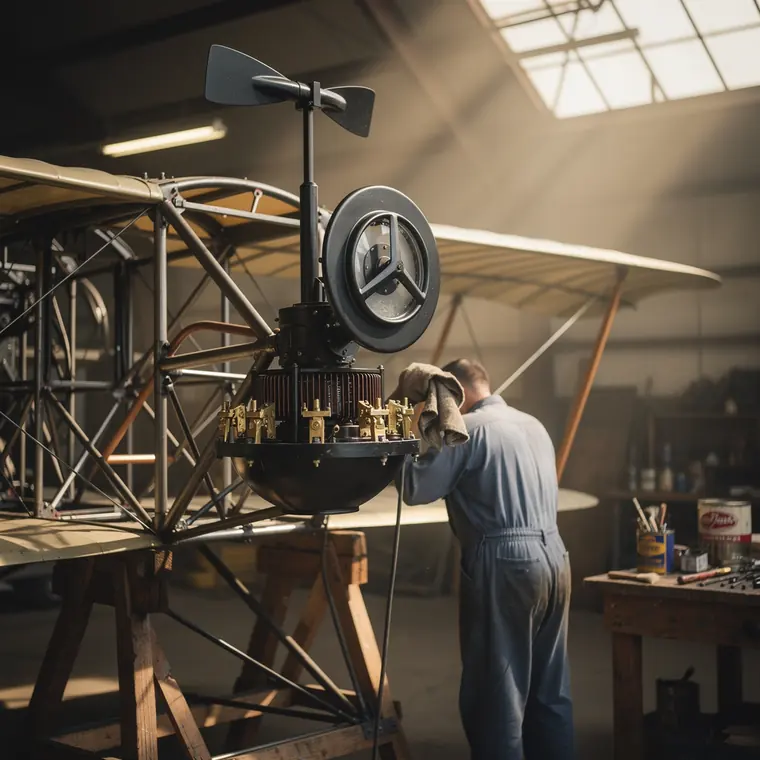
An earth inductor course instrument of 1927 mounted in the open rear fuselage of a high-wing aircraft on wooden trestles in a factory in California, a lattice of welded steel tubes, the instrument seventy centimetres tall, matt black throughout, at the top a flat drum-shaped wind wheel twelve centimetres across on a thin vertical tube thirty-five centimetres long, the tube ending on a round black plate thirty centimetres across with three spokes and glass windows between, below it a bowl-shaped generator housing with brass terminal clamps, a mechanic in blue overalls seen from behind drawing a cloth-wrapped cable forward, a workbench with tins of dope, daylight from a skylight.
- What it was used for
- A course-keeper for aircraft, built by the Pioneer Instrument Company and described in 1927 in "Aero Digest" by Brice Goldsborough, one of the firm's engineers. Three parts: a generator with no artificial field - the field is the earth's magnetic flux, the armature gimbal-mounted -, a mechanical controller and a zero-centre indicator. A small windmill on top of the fuselage spins the armature; the controller rotates the brushes around the commutator and is set to the desired course, its dial carrying 36 divisions. The pilot turns until the indicator reads zero and keeps it there. The reason, per Goldsborough: the magnetic compass is disturbed by engine parts, ignition accessories and moving control components, and compensating magnets are uncertain and need frequent checking.
- What was new
- What was new was separating the sensing element from the indicator: the instrument in front of the pilot no longer holds a magnetic needle that could be disturbed, and the spinning armature, per Goldsborough, additionally acts like a gyroscope against motion that would unsettle it. The barb: the Smithsonian writes that Lindbergh relied on a compass of this type to maintain course on the way to Paris until it malfunctioned. He reached the coast of Ireland 5 kilometres - 3 miles - from his intended great circle course, but, according to the Smithsonian, he knew himself that chance, not skill or equipment, had allowed such accuracy: the winds had caused no significant drift.
What the sources leave open: The description of how it works is by Brice Goldsborough, an engineer of the maker, Pioneer (Aero Digest, June 1927). The article stresses the advantages; the only limitation it names is that the reciprocal heading also reads zero.