The Standard Chronometer
1942 · Standardised Marine Chronometer · Work 787 of 1,871
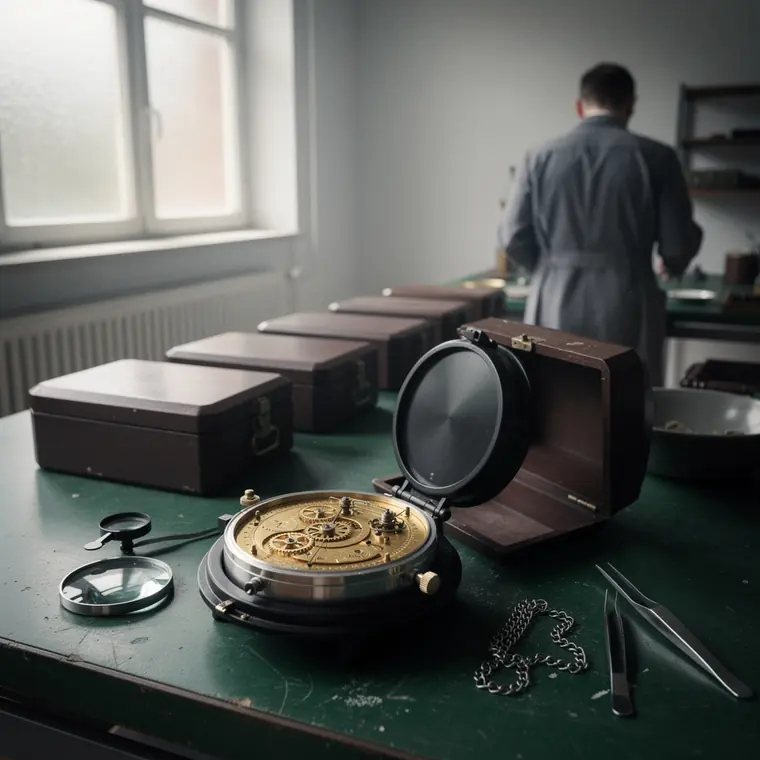
Six identical marine chronometers of 1943 in a row on a green linoleum bench in a whitewashed workshop in Saxony, each in a square dark brown plastic box with a hinged lid, the nearest chronometer lifted out and laid movement upward, a round gilded plate ten centimetres across in a bright steel ring within a black gimbal ring, on it a large balance wheel with a cut compensation rim, a fusee and a fine chain, beside it a loupe, tweezers and a length of loose chain, the other boxes closed, a watchmaker in a grey coat seen from behind at the far end, cold daylight from frosted windows on the left.
- What it was used for
- A ship's chronometer, Model 21, made by the Hamilton Watch Company of Lancaster, Pennsylvania. Navigators of the US Navy, the merchant marine and the Army used it to find longitude: the clock kept the time of a place of known longitude such as Greenwich, and the difference from local time gave the position, 1 hour being 15 degrees. Before the war the US military's chronometers were, according to the Smithsonian, mostly imported; only a few American firms assembled them from European parts. When European supplies stopped in 1941 an acute shortage followed. The Smithsonian gives, for the war years, 8,900 chronometers for the Navy, 1,500 for merchant shipping and 500 for the Army; the price per instrument fell from $625 to $390 between 1942 and 1944.
- What was new
- What was new was not the chronometer but its mass production in the United States. The Naval Observatory approached American watch manufacturers in 1939; Hamilton and Elgin agreed, and on the Smithsonian's account only Hamilton met the Navy's accuracy requirement, delivering 2 prototypes on 27 February 1942. The figure of 1.55 seconds per day is attributed differently: the Smithsonian writes that the prototypes passed with that error rate, while Hamilton itself gives it as the Navy's requirement and claims half a second a day for the Model 21. The design departed deliberately from European practice, above all in escapement, balance and hairspring. According to an article by William R. Smith in the NAWCC Watch & Clock Bulletin (January/February 2012), Hamilton believed the escapement detents could not be mass-produced; the watchmaker V. E. Van Hoesen of Memphis then produced them in quantity.