The Goon Box
1942 · Pulse Timing Radio Navigation · Work 788 of 1,871
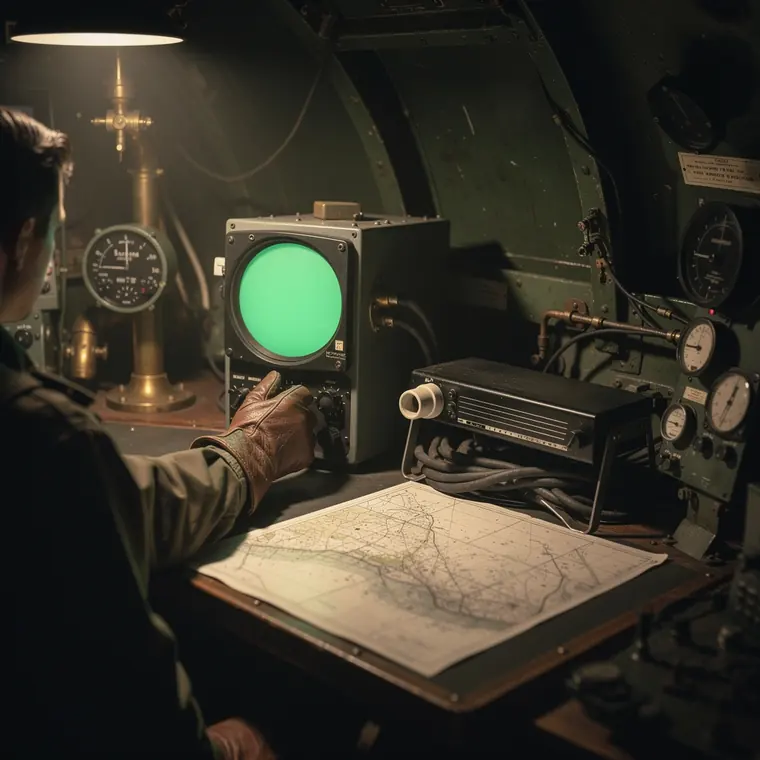
A radio navigation indicator of 1942 on the navigator's chart table in a four-engined bomber at night, a grey-black metal box thirty centimetres wide with a round glass screen in its front glowing a plain soft green, rows of plain black knobs beneath, in a cradle beside it a long black receiver box fifty centimetres long with a pale round socket on its end face, thick cables between the boxes, on the table a chart sheet at a flat angle, soft in focus, a hand in a brown leather gauntlet on one knob, the curved wall of plain dark painted metal, greenish glow from the screen on everything.
- What it was used for
- The Type R1355 receiver of the British Gee radio navigation system, fitted in RAF bombers. The navigator compared the arrival times of pulses from a master station and 2 slave stations and read off his position. The Royal Air Force Museum describes the set as having few components and being easy to fit in most aircraft; Gee entered service with Bomber Command from March 1942, which allowed many aircraft to attack one target within a short time. The Imperial War Museum records the R1355 with its RF26 radio frequency unit as 500 x 310 x 240 mm and 18 kg.
- What was new
- The hyperbolic principle was not new: William J. O'Brien had the idea of position fixing by phase comparison as early as 1936 to 1938, and according to the IET Archives even his was not the first such system. What was new was a receive-only set simple enough that, on the RAF Museum's account, anybody could use it - hence the nickname "the goon box". Because the sets only listened, any number of aircraft could use the same transmissions. The barb is in the same museum description: the Germans soon jammed Gee over occupied territory, after which it still helped with course-keeping and a safe return - the set anyone could use ended up finding the way home rather than the target.