The Loran Receiver
1942 · Hyperbolic Pulse Navigation · Work 789 of 1,871
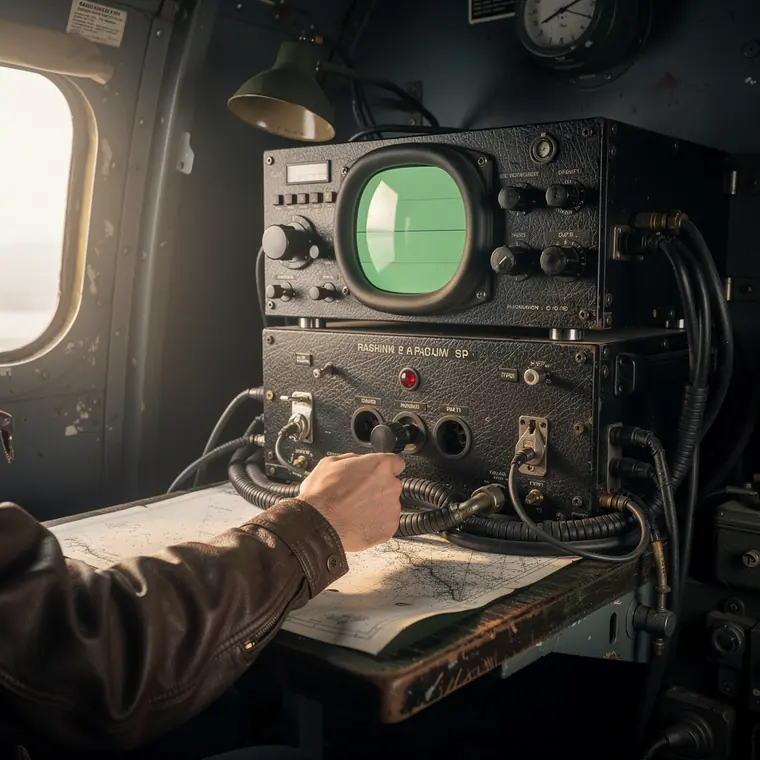
A long-range radio navigation set of 1944 on the navigator's table in a maritime patrol aircraft, two black crinkle-painted metal boxes fifty centimetres long, one above the other, the upper with a round glass screen inside a dark rubber hood glowing a plain soft green, rows of plain black knobs beside it, the lower with five round sockets in a row, two toggle switches and one small red lamp, thick cables between them, a sea chart flat on the table, soft in focus, a hand in a brown leather sleeve turning a knob, walls of plain dark painted metal, a small hooded lamp, pale daylight from the window.
- What it was used for
- A receiver-indicator carried by ships and aircraft, measuring the time difference between the pulses of 2 station pairs and giving a position from it. The first permanently operating Loran-A transmitters stood from June 1942 at Montauk Point, New York, and on Fenwick Island, Delaware. John Merrill, in The Submarine Review, records an order for 250 shipborne receivers placed with the Fada Radio & Electric Company and names Philco as the builder of aircraft receivers; trials were flown from the blimp K-2 on 13 June 1942 and run at sea aboard USS Manasquan from 17 June to 17 July 1942. The IEEE Milestone page gives, after J. A. Pierce, 75,000 receivers delivered by 1946 and 2.25 million charts.
- What was new
- The pulsed time-difference method had been shown by the British Gee, proposed according to John Merrill in 1937; what was new was the range: Gee worked by line of sight on 20 to 85 MHz, Loran on 1,950 kHz with groundwave and skywave. As with Gee, the receiver only listened: any number of ships and aircraft could use the same transmissions at once, and the equipment aboard gave the enemy nothing about one's own position. The IEEE Milestone page gives a groundwave range over seawater of about 700 nautical miles by day and about 500 at night, about 1,400 miles at night by skywave, but over land seldom more than 250 miles by day. The price of that reach was roughly 70 transmitting stations at the end of the war, manned on Greenland, the Aleutians, Iwo Jima and Okinawa. Built as a wartime expedient, the chain stayed: the US Coast Guard operated Loran until 2010.