Chocolaterie Menier Noisiel
1872 · Iron Frame with Brick Infill · Work 79 of 1,871
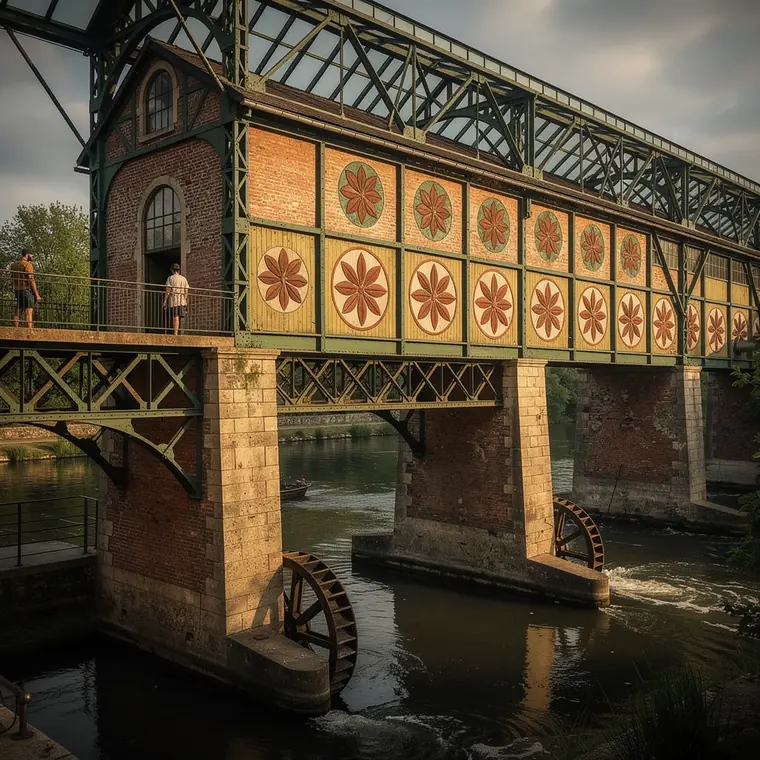
The Menier chocolate mill at Noisiel straddling the Marne on masonry piers, its diagonal iron lattice frame filled with patterned brick panels bearing cacao flower motifs, water wheels below.
- What it was used for
- Jean-Antoine-Brutus Menier, a maker of pharmaceutical products in Paris, took over an existing mill on the Marne in 1825 to grind pharmaceutical powders. Chocolate came in as a coating for the active substances, and both ran side by side until 1862; in 1863 his son Émile-Justin decided to give Noisiel over entirely to chocolate. The coating had eaten the product. The mill building of 1871-72 stands on piers in the river, water turbines drive the cocoa mills, and the process runs down through three floors. Until 1914 it was, according to the Bibliotheque nationale de France, the largest chocolate factory in the world. Production ended in 1994; from 1996 to 2020 the headquarters of Nestlé France sat here, and the works have stood empty since, awaiting conversion.
- What was new
- Iron at the time was normally hidden behind stone. Here the framework is visible and load-bearing: the heritage record says the walls are conceived as the girders of a bridge, a rectangular frame of plate girders and angles; the brick is only infill and forms the Menier M and the cocoa flower in its pattern. 460 tonnes of metal over 485 square metres of ground area. It is not the first iron skeleton - the literature calls it one of the first buildings with a fully metallic frame and points to the great forge at Le Creusot of the 1860s. What is new is that the structure is also the ornament. The frame is by Armand Moisant, the ceramics by Émile Muller.
Further reading
- Plateforme ouverte du patrimoine, Mérimée IA77000031 (Moulin Saulnier)
- Plateforme ouverte du patrimoine, Mérimée IA77000030 (chocolaterie Menier)
- Ville de Noisiel: Histoire de Noisiel
- BnF, Passerelles: La chocolaterie Menier (460 t Metall, größte Schokoladenfabrik der Welt bis 1914)
- Fondation Napoleon: L'architecture metallique sous le Second Empire
- Traits Urbains: Noisiel, de la chocolaterie Menier à la Cité du goût (Wegzug Nestlé 2020)