The Ammonia Clock
1949 · Ammonia Absorption Frequency Standard · Work 791 of 1,871
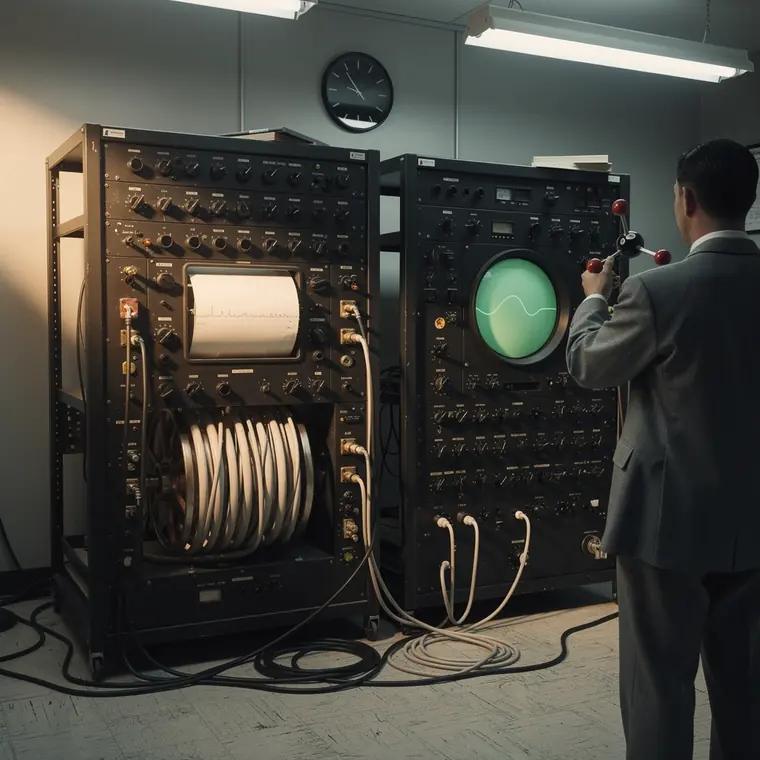
The ammonia absorption clock of 1949 in a standards laboratory in Washington, two black steel equipment racks two metres tall, their front panels filled with rows of plain black knobs and small dark lamps, in the left rack a recorder window with a moving strip of pale paper and a round housing wrapped in coils of pale waveguide tube, in the right rack a round oscilloscope window glowing green with a single shallow curve, above both racks a plain round wall clock with a plain black face at a slant, a physicist in a grey suit seen from behind holding a ball-and-rod molecule model, cables on a linoleum floor, fluorescent light overhead.
- What it was used for
- An atomic clock at the National Bureau of Standards in Washington, built by Harold Lyons and his colleagues. A quartz oscillator was electronically stabilised on the inversion line of the ammonia molecule at 23.8 GHz; at its heart was an 8-metre waveguide absorption cell filled with ammonia, and frequency dividers produced a 50 Hz signal from it. Michael A. Lombardi, writing in IEEE Instrumentation & Measurement Magazine (December 2011), notes that the analogue clock display was there only for show. First operated on 12 August 1948, and publicly demonstrated in January 1949.
- What was new
- What was new was tying a clock's rate to a molecular resonance rather than to a pendulum, a balance or the rotation of the Earth. The barb is in the result: Lombardi gives a best reported accuracy of about 2 ms per day (2 x 10^-8) and writes that the clock failed to outperform the best quartz clocks of its time and never served as a time standard, and that work on a third version was stopped because atomic beam techniques promised a significant increase in accuracy. NIST's own centenary page says the performance of the original clock was only slightly better than existing standards.
Connections
Every connection names its kind. “Forerunner” on its own would be a claim.
- Follows fromThe Quartz Crystal Clock1927Harold Lyons himself described his clock as a device with two pendulums: a quartz crystal and a collection of ammonia molecules. The quartz oscillator set the rate; the ammonia served to correct small errors and irregularities in the crystal-controlled oscillator. Frequency dividers brought it down to about 60 cycles to drive the clock motor.Source: Harold Lyons, Atomic Clocks, Scientific American 1957 (PDF im NIST Time and Frequency Archiv) · Nelson u. a., The leap second: its history and possible future, Metrologia (PDF im NIST Archiv)