The Transit Satellite
1960 · Doppler Satellite Navigation · Work 793 of 1,871
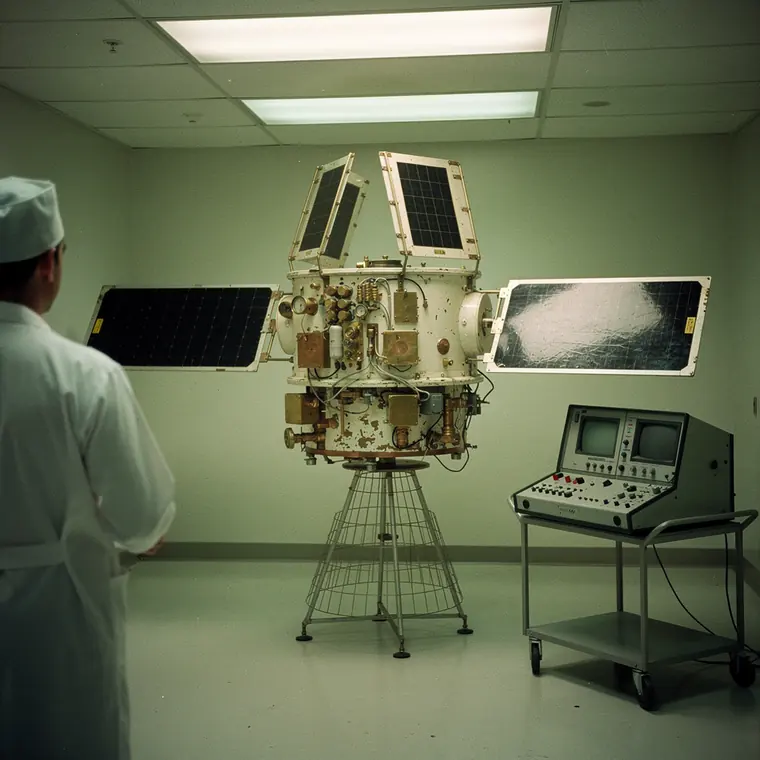
A navigation satellite of 1962 on a low assembly stand in a clean room in Maryland, a short cylinder sixty centimetres across and forty-five high painted matt white, small boxes and stubs on its curved side, four long flat solar paddles each nearly two metres long with dark blue cell panels in pale frames, two folded out level and two folded up against the body, below the cylinder an open cone of thin wires forming the antenna frame, beside it a rolling cart with a grey instrument, a technician seen from behind in a white coat and cap, cold light from ceiling panels, pale floor, bare pale walls.
- What it was used for
- Transit 1B, an experimental satellite of the US Navy's Transit navigation system, launched on 13 April 1960 from Cape Canaveral by a two-stage Thor Able-Star into an orbit with a 475-mile apogee and a 235-mile perigee. Captain Robert F. Freitag described the method in the US Naval Institute's Proceedings of May 1961: the receiver aboard measures the Doppler shift of the satellite's signal, and from that shift and the known orbit the ship's own position follows. IMarEST records that the system was developed for the US Navy to give its Polaris ballistic missile submarines an accurate position; it entered fleet service in 1964 and later achieved roughly 200 m accuracy per pass.
- What was new
- What was new was getting a position out of the Doppler shift of a satellite's signal - the inverse of the idea that, on IMarEST's account, two American physicists had in October 1957 when they observed the Doppler shift of Sputnik's signals: that its orbit could be determined from them. In 1961 Freitag expects fixes "accurate to 0.1 mile or better", and elsewhere in the same article calls 0.5 mile possible. The barb lies in the timing: there was a fix only while a satellite stood above the horizon. Freitag expected, with 4 satellites, a fix at least every 1.5 hours; IMarEST records that at the equator the gap between fixes ran to several hours.
What the sources leave open: Freitag gives 0.1 mile as the expected accuracy and elsewhere 0.5 mile as possible, without reconciling the two; an experimental fix on Austin, Texas, came within a quarter of a mile.