The Quartz Prototype
1967 · Quartz Wristwatch Movement · Work 794 of 1,871
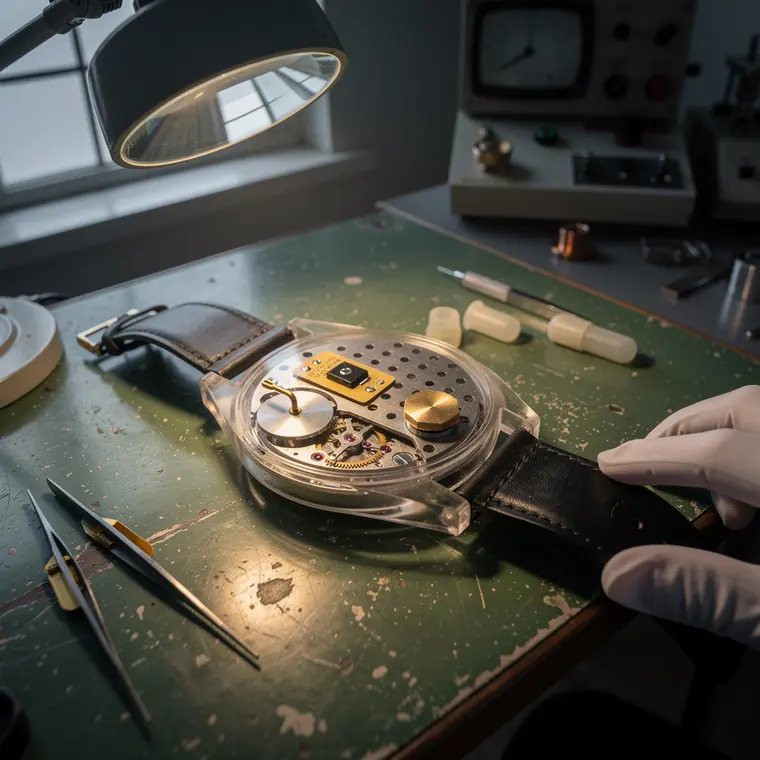
A prototype quartz wristwatch of 1967 on a green linoleum bench in an observatory laboratory in Neuchâtel, its back upward under a magnifier lamp, a tonneau-shaped case of clear acrylic thirty-five millimetres wide on a black leather strap, through the clear back a silver-grey plate pierced with small holes, on it a round button cell under a brass clip, beside it a gold-coloured circuit sheet with a small black block and a hexagonal brass cap, a tiny gear train with red jewels in the centre, its front pressed against the bench, tweezers and rubber finger cots nearby, a white-gloved hand steadying the strap, north light from a tall window.
- What it was used for
- The Beta 1 quartz wristwatch prototypes of the Centre Electronique Horloger (CEH) in Neuchâtel, tested at the international chronometric competition at the observatory there. Armin H. Frei, then a member of the CEH research staff, reports that the first unit of a series of 5 was assembled and tested in July 1967; the watch CEH-1020 was tested from 13 August 1967 and reached a classification figure of 0.189, and 10 further CEH quartz watches (Beta 1 and Beta 2) were later delivered for testing. Suwa Seikosha also developed a quartz wristwatch prototype in 1967 and entered the Neuchâtel competition for the first time with a quartz wristwatch; it had first competed there in 1963 with a marine chronometer.
- What was new
- The IEEE Milestone plaque of 2002 credits the CEH with the first prototypes incorporating dedicated integrated circuits, which set new performance records at the chronometric competition. Who was first is unsettled, and is disputed by the participants themselves: Frei gives averages of the 4 best watches of each maker of 0.166 for CEH and 0.873 for Seiko, which had submitted four quartz wristwatches on 11 November 1967, and holds Beta 1 to be the first quartz wristwatch because Seiko published no details of its prototype. The barb: Seiko sold the Astron 35SQ to the public on 25 December 1969 at $1,250, 100 of them in gold in the first week, while the first 1,000 Beta 21 reached the market only on 10 April 1970.
What the sources leave open: The claim that Beta 1 was the first quartz wristwatch comes from Frei himself and from a website run by his estate; the opposing side (Forrer and others) is not represented among the sources here.
Further reading
- Armin H. Frei, First-Hand: The First Quartz Wrist Watch, Engineering and Technology History Wiki
- Milestones: Pioneering Work on the Quartz Electronic Wristwatch, 1962-1967, IEEE (verliehen 28. September 2002)
- Milestones: Electronic Quartz Wristwatch, 1969, IEEE (verliehen 25. November 2004)
- Historical Facts and Misrepresentation, quartzwristwatch.org (Dr. Armin H. Frei Heritage Estate)