The Apollo Sextant
1968 · Spacecraft Optical Navigation · Work 795 of 1,871
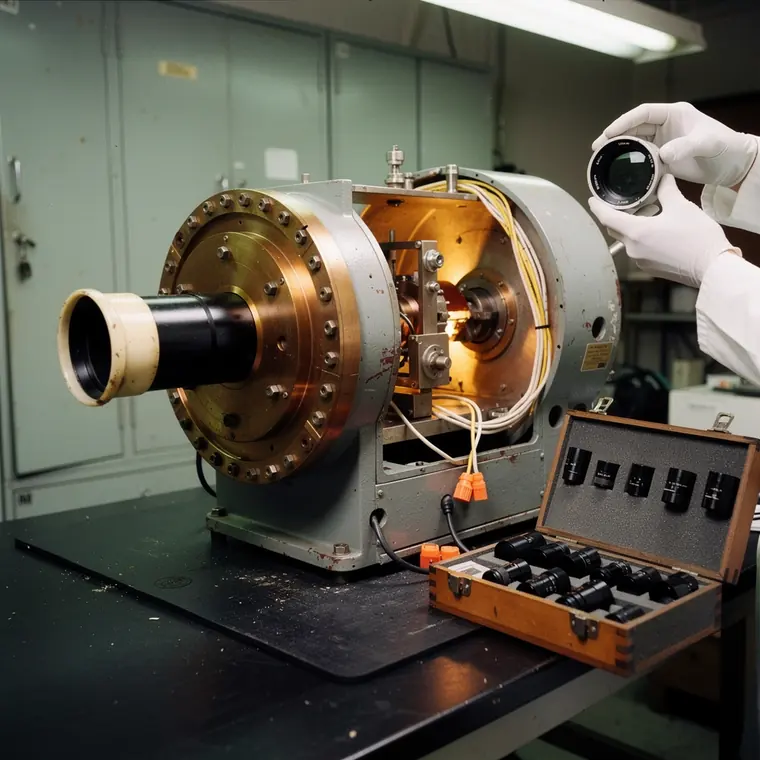
The optical head of a spacecraft sextant of 1968 on a test bench in an instrument works on Long Island, a grey cast-metal block fifty-five centimetres long on a black rubber mat, its middle a thick round flanged plate fifty centimetres across with a ring of bolt heads, to the left a black cylindrical tube ending in a cream-white eyepiece ring, to the right the open interior with mirror and prism mounts, a small motor housing and bundles of white and yellow wires, orange caps on the connectors, beside it an open wooden case of eyepieces in foam, two white-gloved hands holding an eyepiece, fluorescent light, grey cabinets along a bare wall.
- What it was used for
- Part of the navigation system in the Apollo command module: a wide-field scanning telescope and beside it a 28-power sextant built by the Kollsman Instrument Company. The astronauts used it to align the inertial platform on stars and to measure the angle between a star and the horizon of the Earth or the Moon; the value went to the onboard computer as a serially incremented count of 10 arc seconds per count. David G. Hoag records in his MIT Instrumentation Laboratory report E-2411 of April 1969 that ground tracking remained the primary source of midcourse navigation and that the onboard measurements were to confirm a safe trajectory and provide a backup for return to Earth. First used on the way to the Moon on Apollo 8 in December 1968.
- What was new
- What was new was that a manned capsule could determine its own trajectory even if help from the ground became unavailable. The barb: Hoag writes that at great distance from Earth the sextant's measuring accuracy was the predominant source of error, and that the horizon does not provide a distinct target, made even more indistinct at higher altitudes by the filter in the beam splitter. The height of the horizon was also uncertain: Lovell had set it at 32.8 km in the simulator, in flight it was corrected to 18.2 km, and a later estimate put it at about 23 km. It did not decide the outcome: the perilune altitude determined on board ended at 67.5 nautical miles, only about 1.3 nautical miles below the value later reconstructed from ground tracking.
What the sources leave open: The ION Museum names Apollo 8 as the sextant's first test; according to Hoag's 1969 report the optics had already flown on Apollo 7, and Apollo 8 was their first lunar flight.