Meine Herren!
1899 · The Revolutionaries · Work 800 of 1,871
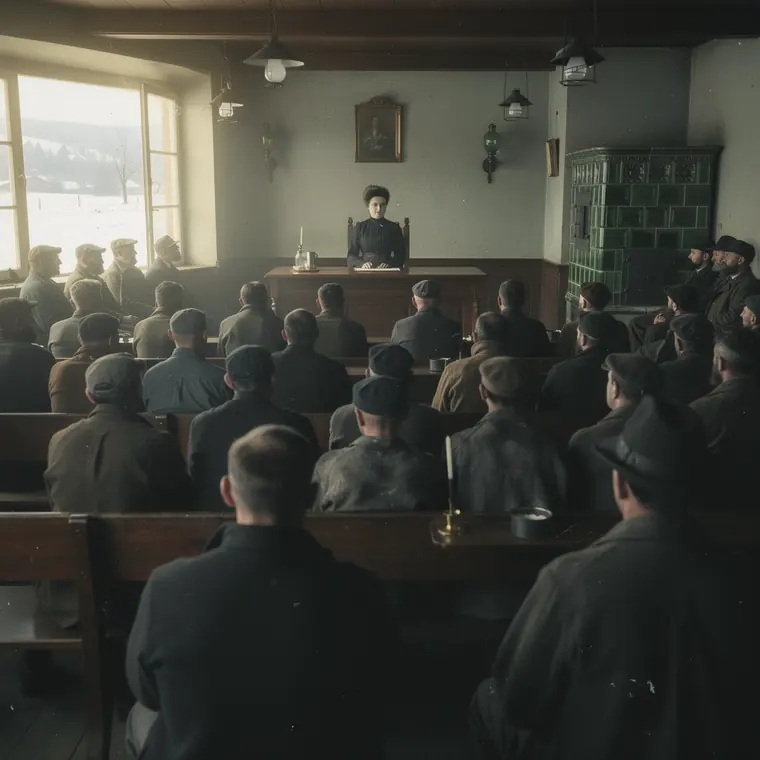
A crowded political meeting, two hundred men filling every bench and standing shoulder to shoulder along the walls and at the back, the speaker a small woman standing upright behind the table at the front wall, the hall of a village inn at Bielschowitz in Upper Silesia, three in the afternoon, Sunday 31 December 1899, a low room, whitewashed walls, wooden floor, petroleum lamps hanging dark from the beams, a tiled stove in the far corner, tall windows along the left wall giving pale grey winter light and a view of snow-covered fields, the hall packed with some two hundred men on benches and standing at the sides and back, seen from behind in half shadow, most of them miners, some in dark Sunday jackets and bowler hats, others straight from the shift in coal- blackened work clothes and flat caps, faces and hands black with coal dust, at the front wall a plain committee table with a water jug, seated at its right end a moustached man in his thirties in a dark jacket, his face in shadow, and standing behind the middle of the table, small against the whitewashed wall, lit from the left by the windows, is the woman, a small woman of twenty-eight with dark hair pinned up, in a dark high-necked winter dress, her hands on the table edge, her face toward the hall and the camera as she begins to speak.
- Who
- Rosa Luxemburg (1871–1919) was one of the best-known voices of socialism in Europe. Born into a Jewish merchant family in Zamość, in the Russian-ruled part of Poland, she fled to Switzerland in 1889 and took her doctorate in Zurich in 1897. To become a Prussian citizen she entered a sham marriage with Gustav Lübeck in 1898 and moved to Berlin, where she belonged to the left wing of the SPD. In "Social Reform or Revolution?" (1900) she took on the reformers in her own party; her main work, "The Accumulation of Capital", appeared in 1913. She openly opposed the First World War and spent almost all the time from 1915 to November 1918 in prison. Afterwards she worked for the Spartacus League and helped found the KPD. She wanted revolution, but criticised Lenin's centralised party and the Bolsheviks' suppression of freedom: "Freedom is always the freedom of the one who thinks differently", she noted in 1918. On 15 January 1919 soldiers of the Guards Cavalry Rifle Division abducted and murdered her in Berlin and threw her body into the Landwehr Canal. A political foundation bears her name today.
- The moment
- On Sunday 31 December 1899, at three in the afternoon, Rosa Luxemburg spoke at Bielschowitz near Zabrze in the Upper Silesian coalfield. The hall lay far out "in the fields" and was nonetheless packed: a little over 200 listeners, most of them miners. The trade unionist August Winter opened the meeting. Luxemburg's subject was "Principles and Aims of Socialism"; she greeted the men with "Meine Herren!", "Gentlemen!". The day before she had written to the Kautskys: "Some of the miners come straight from work, black all over with coal." The coal that had turned Upper Silesia into an industrial landscape was still on her listeners' faces. The picture shows the 28-year-old behind the table at the front wall, the men of the shift before her.
- The other side
- A full hall could not be taken for granted. In the election campaign of June 1898, by Luxemburg's own account, "holding public meetings" had been impossible here; workers were dismissed and some leaflet distributors arrested. At the first meeting of this tour, on 26 December 1899, the police refused permission to light the hall, and it had to end at nightfall. Hardly an innkeeper was yet willing to lend his hall. The small evenings over beer, she wrote, moved people more than the speeches, and "a Polish word works quite differently from the foreign German one".
What the sources leave open: The name and look of the inn are not recorded; the hall in the picture is typified. Whether lighting was permitted on 31 December is unknown, so the lamps hang dark. What Luxemburg wore is not described, nor whether she spoke German or Polish. The letter quotations come from an account by the Rosa Luxemburg Foundation; the original letters were not consulted.
Further reading
Sources
- Holger Politt: „Halbasien“. Rosa Luxemburgs Agitationsreise nach Oberschlesien 1899, Rosa-Luxemburg-Stiftung Brandenburg
- Rosa Luxemburg: Die Wahlen in Oberschlesien (LVZ, 2.7.1898), Gesammelte Werke 1.1, S. 218
- Deutsches Historisches Museum, LeMO: Biografie Rosa Luxemburg
- Neue Deutsche Biographie: Luxemburg, Rosa (Iring Fetscher)
- Historisches Lexikon der Schweiz: Luxemburg, Rosa (Markus Bürgi)
- Rosa Luxemburg: Zur russischen Revolution (1918, ersch. 1922), Teil 4, Randbemerkung (Marxists Internet Archive)