Watt Double-Acting Engine
1782 · Double Acting Engine · Work 83 of 1,871
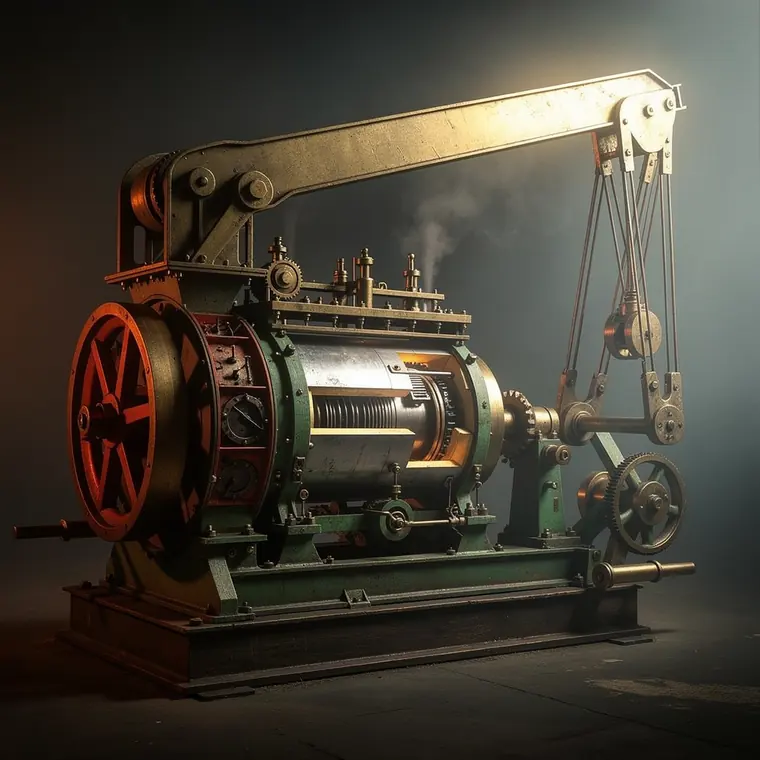
A double-acting beam engine in cutaway, steam admitted to both sides of the piston, valve chest opened to show the passages, parallel motion linkage at the beam end.
- What it was used for
- The most tangible example is today in Sydney, at the Powerhouse Museum: the engine delivered in 1785 to Samuel Whitbread's London brewery and given to the Technological Museum in Sydney in 1887. Cylinder 24 inches, stroke 6 feet, at first single-acting at about 17 indicated horsepower. In 1795 it was converted to double action, which doubled the power to perhaps 35 hp. It drove the brewery until 1887, 102 years. That is the real job of the double-acting engine: not to lift water but to pull a line shaft evenly, with malt mills, grinding and pumps hanging off it.
- What was new
- The atmospheric engine worked in one direction only; the return was a dead stroke. Watt's patent no. 1321 of 12 March 1782 admitted steam alternately to both sides of the piston. One working stroke per revolution became two, and the same cylinder gave roughly twice the power. The price was mechanical: the piston now had to push as well as pull. A chain cannot do that, so a rigid rod was needed, and a guide to keep it moving straight while the beam end swung through an arc. That was the parallel motion, patent no. 1432 of 24 August 1784: an invention that existed only because the previous one had torn a hole.
Connections
Every connection names its kind. “Forerunner” on its own would be a claim.
- Follows fromWatt Separate Condenser1769The double-acting engine kept the separate condenser. The ASME landmark for the 1785 Whitbread engine lists Watt's innovations side by side: condenser, parallel motion, centrifugal governor, sun-and-planet gear, double-acting cylinder. It was built single-acting; the conversion to double action in 1795 doubled its power output according to the ASME, the Powerhouse Museum gives 10 and 15 hp.Source: ASME Landmark: Boulton & Watt Rotative Steam Engine (Whitbread-Maschine 1785; separate condenser, double-acting cylinder, Umbau 1795) · Powerhouse Collection: Boulton and Watt rotative steam engine, 1785 (ursprünglich 10 PS; beim Umbau auf Doppelwirkung Wahl zwischen 15 und 20 PS, gewählt 15; getrennter Kondensator, Parallelführung, Regler, Sonnen- und Planetengetriebe)