Watt Separate Condenser
1769 · Separate Condenser · Work 82 of 1,871
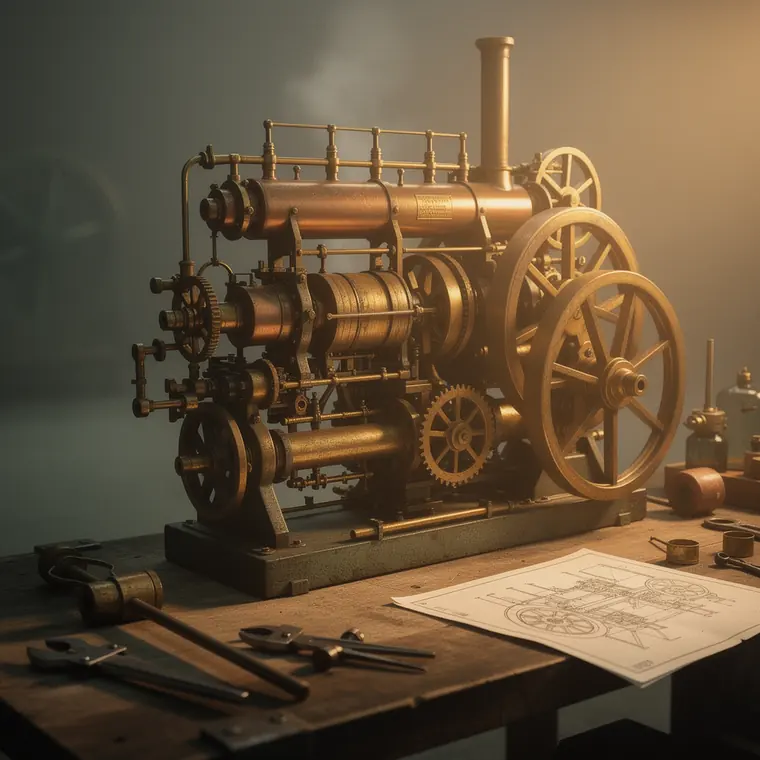
Watt's separate condenser apparatus on a workshop bench, copper vessel and connecting rod, calipers and technical drawings weighted down at the corners.
- What it was used for
- The separate condenser was as much a business model as a component. Boulton & Watt sold not so much engines as the right to save coal with them; the surviving agreements in the Boulton & Watt archive state cylinder bore and stroke, what the engine was for, and the payment, usually an annual premium. The first large customers were the tin and copper mines of Cornwall, where coal arrived by sea and every ton saved was cash. The Science Museum puts the saving at two thirds of the fuel. Steam power was no longer tied to the coalfield; it became affordable in mills and workshops as well.
- What was new
- The atmospheric engine had to heat and cool the same cylinder every stroke. The Science Museum states the contradiction plainly: for fuel economy the cylinder must stay hot, for the vacuum it must be cooled. Watt's patent no. 913 of 1769 separated the two by condensing the steam in a vessel of its own, kept permanently cold. What was new was not the vacuum but that the same work was done on a third of the coal. The barb is legal: an Act of Parliament extended the patent to 1800 in 1775, and the firm enforced it hard, against Edward Bull, against Hornblower & Maberly, and in 1792 against Jonathan Hornblower's bid to extend his own compound patent. Whether this actually held technology back is disputed among economic historians.
Connections
Every connection names its kind. “Forerunner” on its own would be a claim.
- Follows fromNewcomen Atmospheric Engine1712In the winter of 1763-64 Watt, instrument maker to the University of Glasgow, was given a model Newcomen engine to repair. Working on that model showed him how much heat the cylinder lost by being cooled every stroke, and the separate condenser followed.Source: University of Glasgow: Model steam engine which inspired James Watt receives Engineering Heritage Award (2019) · University of Glasgow Story: James Watt
- Made possibleWheal Busy Watt Engine1777The engine at Chacewater, later Wheal Busy, erected late in 1777, was the first of its kind in Cornwall. What was sold was not the engine but the saving: Boulton & Watt took one third of the coal it saved against an atmospheric engine of equal power.Source: Historic England, List Entry 1021392: Wheal Busy, Chacewater (Cornwall's first Boulton and Watt condensing engine) · Cornish Mining World Heritage Site / Cornwall Council: Engineers and inventors - overview (PDF; Chacewater 1778, Lizenzbedingung ein Drittel der Kohlenersparnis) · Grace's Guide: Wheal Busy (Maschine Ende 1777, erste ihrer Art in Cornwall)
Further reading
- Science Museum Blog: James Watt and the separate condenser
- Archives Hub / Library of Birmingham, Boulton and Watt Collection MS 3147/2: Legal Records und Agreements
- Archives Hub: Boulton & Watt Legal Records (Bull, Hornblower & Maberly, Opposition gegen Hornblowers Verlängerung 1792)
- ASME Landmark: Boulton and Watt Rotative Steam Engine (Patent Nr. 913, 1769)
- Selgin/Turner, Strong Steam, Weak Patents (zur strittigen Blockadewirkung)