Newcomen Atmospheric Engine
1712 · Atmospheric Engine · Work 81 of 1,871
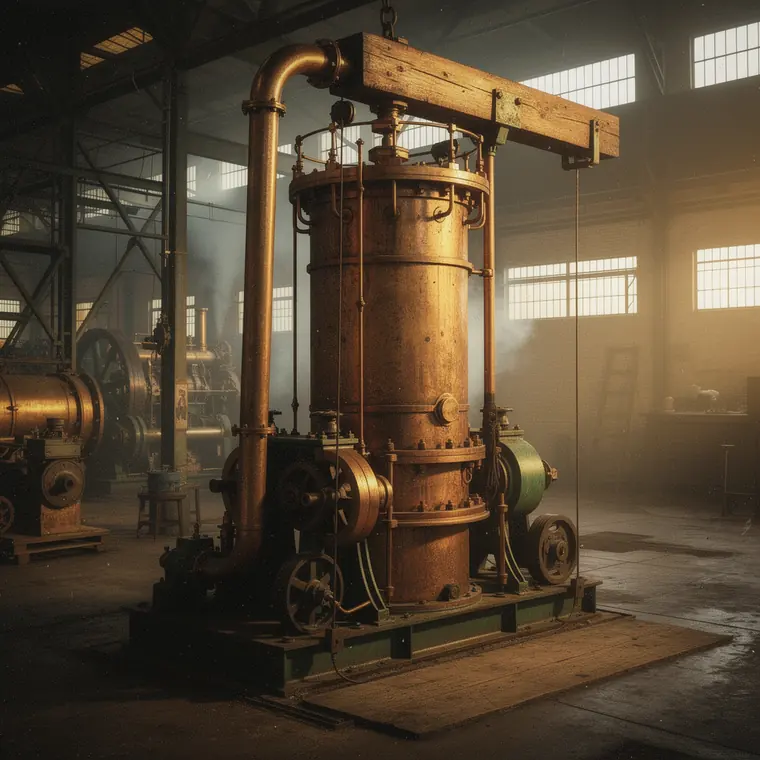
A towering Newcomen atmospheric engine inside a mine engine house, massive oak beam pivoting overhead, brass condensate pipes, coal smoke pooling under the roof timbers.
- What it was used for
- The engine lifted water out of a coal pit. The 1719 print shows it "near Dudley Castle"; according to the note in Nature it stood in the parish of Tipton, above a seam of coal some 24 feet thick. The inscription also gives its performance: the beam swung twelve times a minute and each stroke lifted ten gallons of water 51 yards. Its customers were collieries, not factories. It burned so much coal that it only paid where the coal lay at the pit head. How long the type stayed in use is visible at Elsecar in Yorkshire: the engine of 1795 there, commissioned by the 4th Earl Fitzwilliam, drained the New Colliery until electric pumps replaced it in 1923, and was then kept for emergencies until 1930.
- What was new
- Savery had patented a fire engine in 1698 that raised water directly by steam pressure and vacuum, with no piston and a limited lift. Newcomen put a cylinder and piston in its place: injected water condensed the steam, atmospheric pressure drove the piston down, the rod pulled the pump in the shaft. Power could now be delivered as a sustained stroke, deeper and steadier than a horse gin managed. Newcomen never held a patent of his own. Savery's monopoly was drawn so broadly that Newcomen had to sell under another man's name; it ran until 1733, four years after his death. The reversal came later: between 1775 and 1800, long after Watt's economical engine was available, 616 atmospheric engines were still built in Britain against 479 by Boulton & Watt.
Connections
Every connection names its kind. “Forerunner” on its own would be a claim.
- Parallel toSavery Steam Pump1698The same task, raising water by fire, solved twice over. Harold Dorn writes in the Dictionary of Scientific Biography that Newcomen's work was entirely independent of Savery's and his engine wholly different, yet Savery's broadly drawn patent still forced him to build under another man's licence.Source: Harold Dorn, Newcomen, Thomas, in: Complete Dictionary of Scientific Biography (Volltext bei Encyclopedia.com)
Further reading
- Site of Newcomen's Engine, Nature 130, 692 (1932)
- American Physical Society: Savery's steam engine (Patent 1698, Fire Engine Act 1699, Ablauf 1733)
- Nuvolari/Verspagen, Technical choice, innovation and British steam engineering (Kanefsky-Daten), TU Eindhoven
- Elsecar Heritage Centre: The Birth of Industrial Elsecar