Uniflow Engine
1908 · Uniflow Principle · Work 90 of 1,871
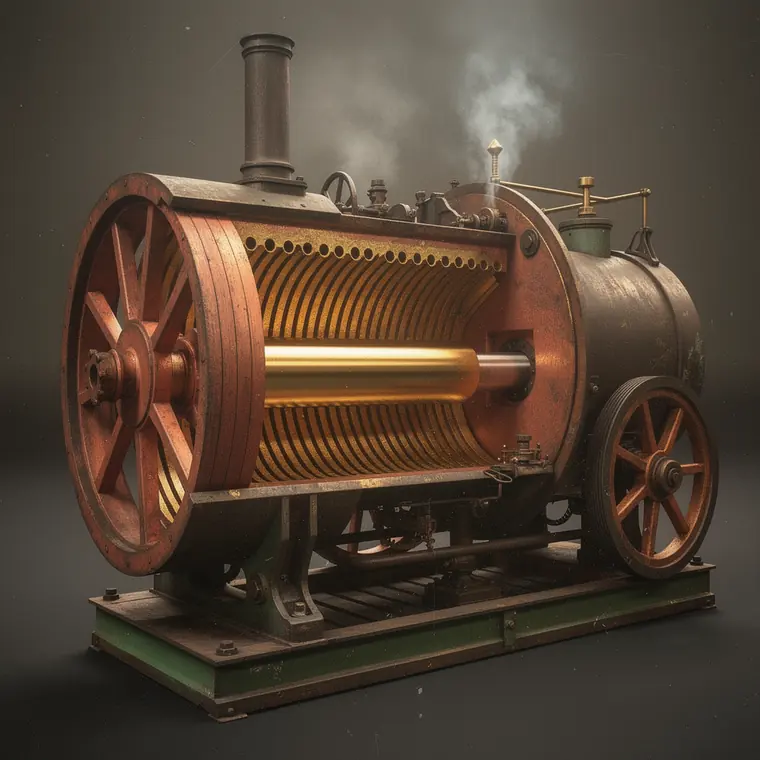
A uniflow steam engine cut open lengthwise, exhaust ports ringing the centre of the cylinder wall, long piston covering and uncovering them at the end of its travel.
- What it was used for
- Uniflow engines drove mills, power stations, winding engines and ships. Sulzer of Winterthur built a three-cylinder uniflow engine for the saloon steamer Helvétie, commissioned in 1926: 850 mm bore, 1200 mm stroke, 1,500 PSe at 40 to 50 rpm. In 1928 the Polytechnisches Journal called the output extraordinary, since marine uniflow engines of this kind and size had not been installed before. In the United States a Skinner uniflow of 1926, 19 by 20 inches at 125 psi, drove a 150 kW direct-current generator at the Stanford hospital in San Francisco until 1974.
- What was new
- The steam travels one way only. It enters at the hot ends of the cylinder and leaves through ports in the middle, uncovered by the piston at the end of its stroke. So it does not wash back and cool the cylinder wall or the piston face; condensation of the incoming steam falls, and a single cylinder reaches an economy that previously required a compound engine. Stumpf did not invent this. In 1916 the Polytechnisches Journal pointed to Joh. Mich. Hack, German patent 6470 of 15 February 1879, as the originator of the uniflow idea, and to Karl Schmid's patent 164956 of 1903 as the landmark for highly superheated steam; Stumpf, it said, recognised and exploited this earlier work with a practical eye, and was fiercely attacked for it at first. In 1922 he wrote that fifteen American firms were by then building on his proposals on a large scale.
Further reading
- Polytechnisches Journal (1916): Zur Geschichte der Gleichstromdampfmaschine (Hack DRP 6470 von 1879, Schmid Patent 164956 von 1903, Stumpfs Rolle)
- Polytechnisches Journal (1928): Die Sulzer-Gleichstrom-Dampfmaschine für den Salondampfer Helvétie
- Johann Stumpf, Die Gleichstrom-Dampfmaschine, 3. Auflage, Vorwort Berlin, im Januar 1922 (Verlagsvorschau Oldenbourg/De Gruyter)
- Smithsonian NMAH: Demonstration Model of a Uniflow Valve for a Steam Engine (Wirkungsweise, Vergleich mit Turbine und Verbundmaschine)
- Roots of Motive Power: Skinner Uniflow Steam Engine (1926, 19x20 Zoll, 125 psi, 150 kW, Stanford Hospital bis 1974)