Grasshopper Beam Engine
1803 · Compact Construction · Work 92 of 1,871
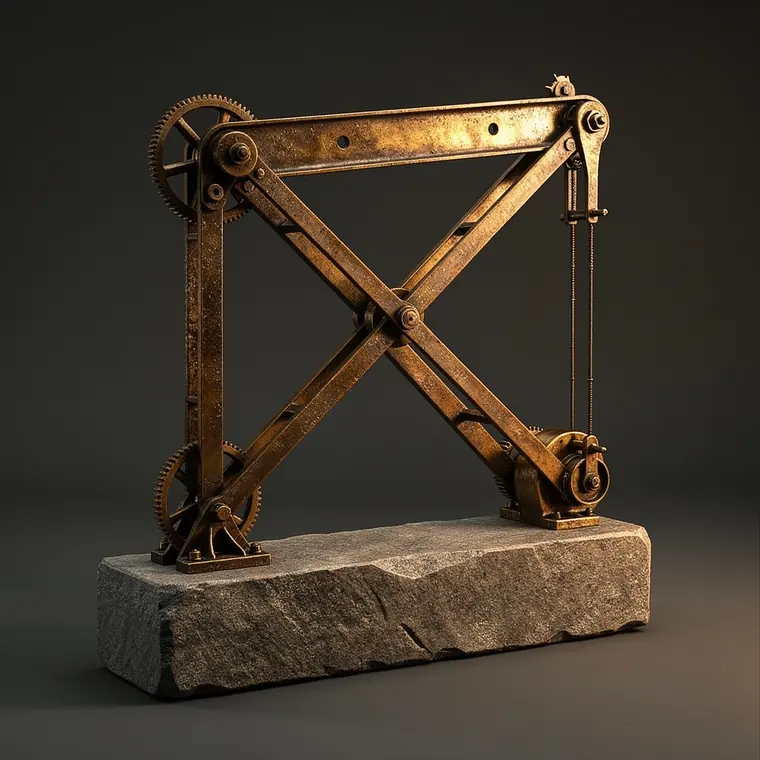
A grasshopper beam engine with the beam pivoted at one end rather than the centre, the whole linkage rocking like a hinged leg, compact frame on a stone base.
- What it was used for
- A half-beam engine whose beam pivots at one end. The Science Museum Group holds two. One, from 1840, maker unknown, gave 5 horsepower at 20 revolutions a minute and ran from 1840 to 1928 at the Clyde Wharf Works of the United Alkali Company in London, making soda ash for the glass, textile, soap and paper trades: 88 years of service out of five horsepower. Of the other, around 1855 and probably by Easton, Amos & Sons, the museum says of the type that it was intended to be small and self-contained, not needing any supporting structure. That is the point of the type: no foundation pit, no engine house, set up wherever there is room.
- What was new
- Who devised the arrangement is unsettled, and the best source says so itself. In a 1962 Smithsonian study Eugene S. Ferguson calls the origin of the grasshopper beam motion "somewhat obscure" and closes by saying concrete evidence is lacking. What is documented, according to Ferguson, is British Patent 2741 of 17 November 1803 by the watchmaker William Freemantle - but that covers a straight-line linkage in which the connecting rod sits at the opposite end of the beam from the piston rod. The arrangement known as the grasshopper, with connecting rod and piston rod at the same end, is associated with Oliver Evans and documented on his Columbian engine before 1813. The practical advantage, a much lighter beam, belonged according to Ferguson to the Evans version, not to Freemantle's.