Bobbin Mill Engine
1835 · Textile Industry · Work 94 of 1,871
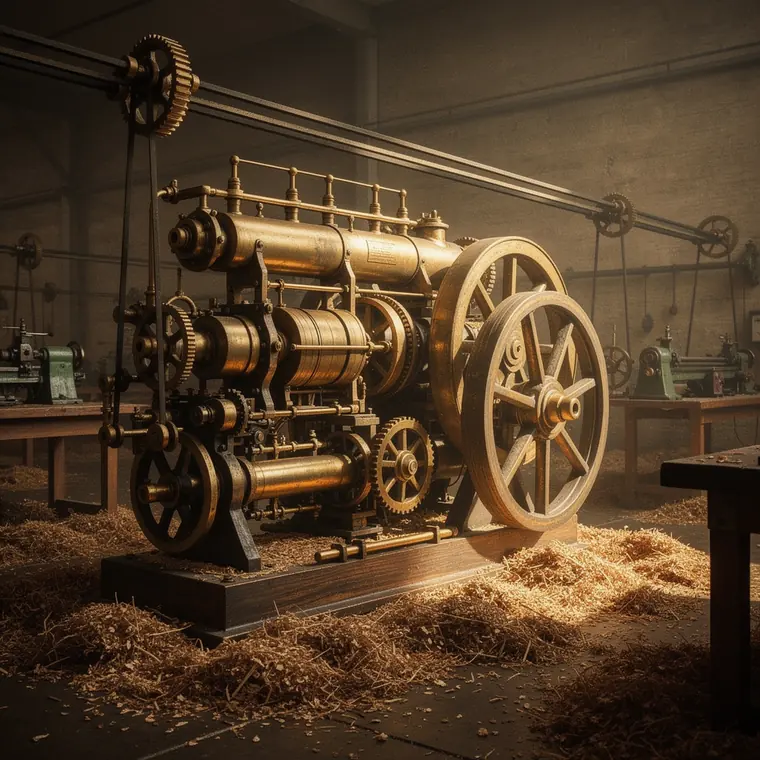
A small mill engine driving line shafting through a bobbin works, flat belts running to lathes along both walls, wood shavings banked up beneath the benches.
- What it was used for
- Stott Park Bobbin Mill, built in 1835 as a speculation by the landowner John Harrison, turned wooden bobbins for the Lancashire cotton mills. The wood came from coppice within a twenty-mile radius. More than a hundred such mills were set up in the Lake District, some sixty of them working around 1860. English Heritage states that Stott Park produced 250,000 bobbins a week; the figure carries no date and no source. Until the Factory and Workshop Act of 1878 boys of eight worked here, up to sixteen hours a day; afterwards ten was the minimum age, and only half-time until fourteen. Power: a waterwheel 9.8 m across, a turbine in or shortly before 1858, and about 1880 a 20 hp single-cylinder steam engine, used only to supplement the turbine when needed; a second turbine followed about 1890. Water remained the main drive until 1941, when two electric motors replaced the steam engine. The mill closed in 1971; the Lancashire cotton trade was shrinking, and bobbins were now made of plastic.
- What was new
- What was new at this mill was not the steam engine but its part: it arrived about 1880 as the last link in a chain of drives and stayed a stand-by. Water drove the works from 1835 to 1941 - first through a wheel 9.8 m across, from 1858 at the latest through a turbine, from about 1890 through two. The steam engine ran only when the water fell short; in 1941 two electric motors took its place. The picture of a steam age in which the boiler drives out everything else does not hold here: where there was a beck, the beck stayed. What carried the works was coppice - alder, ash, birch and willow from within twenty miles, turned for the Lancashire spinning mills, in more than a hundred mills of the kind in the Lake District. They went with the cotton and with plastic, not with steam.