Triple Expansion Engine
1870 · Triple Expansion · Work 96 of 1,871
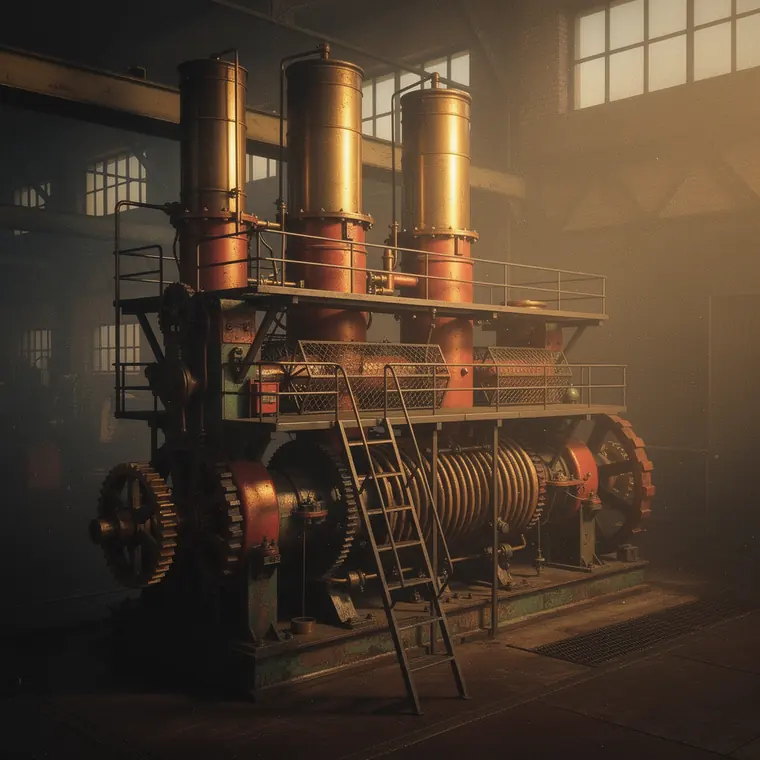
A triple expansion engine seen from the engine room floor, three cylinders of increasing size rising above the crankshaft, ladders and gratings threading between them.
- What it was used for
- It was the engine of the long freight voyage. A. C. Kirk put the case plainly to the Institution of Naval Architects in 1882: every ton of coal saved is a ton of freight earned, and every stop to coal costs time and exorbitant port prices. His "Aberdeen" had cylinders of 30, 45 and 70 inches with a 4 ft 6 in stroke, two boilers built entirely of steel at 125 lb pressure with 7,128 square feet of heating surface, and no superheater. On trial with 2,000 tons of deadweight aboard, consumption measured 1.28 lb of coal per indicated horsepower-hour. The type remained standard in cargo service into the Second World War: the Liberty ships, over 2,700 of them from 18 yards between March 1941 and November 1945, ran on a triple-expansion engine of 2,500 IHP at 76 rpm, 220 lb steam, eleven knots - to drawings from the Joseph L. Thompson & Sons yard at Sunderland.
- What was new
- The year 1870 rests on nothing, and priority cannot be settled. Three obituaries of Daniel Adamson from 1890 say different things about the same event: that in 1861-62 he designed, or built, a triple-expansion engine, or built a triple-cylinder compound. Kirk himself dates his first attempt to 1874, the steamer "Propontis", whose water-tube boilers for 150 lb gave trouble early; around 1878 Douglas & Grant built the engines of the "Isa". The breakthrough was the "Aberdeen" of 1881-82. What was new was not the number of cylinders but dividing the temperature range across three stages instead of two - Kirk's own reasoning. W. Parker of Lloyd's Register said the same evening that the two-cylinder compound was at its limit somewhere between 80 and 100 lb. A third man, E. A. Cowper, objected in the same discussion that he had years before achieved 1.3 lb on 55 lb steam; the gap to 1.28 was one and a half per cent, not twelve.
Further reading
- A. C. Kirk, On the Triple Expansive Engines of the Steamship Aberdeen, INA 29.03.1882, mit Diskussion; in: Naval Professional Papers No. 16, GPO Washington 1884
- ASME Historic Mechanical Engineering Landmark: SS Jeremiah O'Brien (PDF)
- Grace's Guide: Alexander Carnegie Kirk (Nachrufe IMechE 1892, ICE 1893)
- Grace's Guide: Daniel Adamson (Nachrufe IMechE, ICE, Iron and Steel Institute, 1890)