Marine Steam Engine
1850 · Marine Steam Engine · Work 97 of 1,871
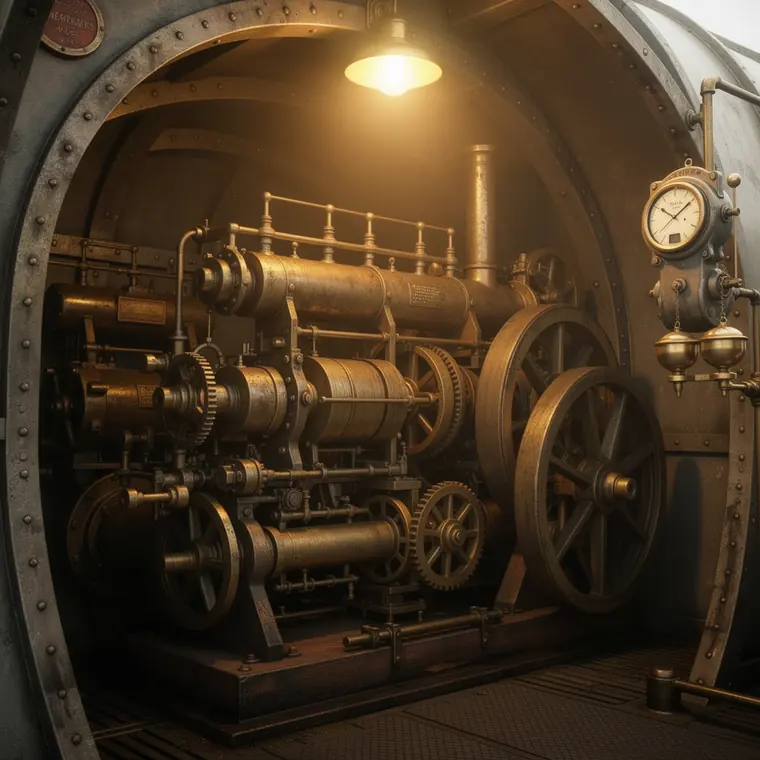
A ship's engine room with the main engine turning between the frames, brass oil cups and telegraph repeater, curved hull plating closing in on both sides.
- What it was used for
- Around 1850 space and weight governed the form, and in screw warships the further demand to stay below the waterline. Out of that came the side-lever engine, the oscillating engine, the trunk engine and the direct-acting engine. The builders are on record: Maudslay, Sons & Field supplied the side-lever engines of the "Rhadamanthus" in 1832 at 220 nominal horsepower; John Penn & Sons of Greenwich built oscillating engines of 1,300 indicated horsepower for the "Magicienne" in 1850. One engine of the kind still runs: the paddle steamer "Diesbar" at Dresden carries the two-cylinder oscillating engine built in 1841 by John Penn & Sons of Greenwich for the paddler "Bohemia" - the Diesbar is its third ship -, 110 hp at 38 rpm; it was designated an ASME landmark in 2008. The ship herself dates from 1884 and is the only coal-fired paddler in the fleet.
- What was new
- What was new was not the principle but the height. The 1832 arrangement gave 220 nominal horsepower with beamwork alongside the cylinder; Penn's oscillating engine of 1850 dispensed with the connecting rod altogether, the cylinder itself swinging on trunnions, and delivered more than three times as much for the same 275 tons of machinery. The trunk engine brought the horizontal cylinder close up to the crankshaft - and later disappeared, because the trunk could not be kept steam-tight. What all these engines shared was a fault that lay not in the engine but in the boiler: it ran on sea water. A quarter to a third of the feed water had to be blown hot over the side to keep the salt from settling out; bottom cocks were opened every two hours or oftener, surface cocks stood constantly an eighth open. Samuel Hall's surface condenser, patent 6556 of 13 February 1834, failed at first through fouling; only about 1860 did it come into general use and make higher pressures possible.
Further reading
- Sennett & Oram, The Marine Steam Engine, Longmans Green & Co. 1899 (Reproduktion)
- Henry Evers, Steam and the Steam Engine: land and marine, London 1873, Kap. X (Naval Marine Archive)
- Sächsische Dampfschifffahrt: Raddampfer Diesbar
- ASME Landmark: John Penn & Sons Oscillating Steam Engine (PDF)
- Grace's Guide: Samuel Hall (Patent 6556, 1834; nach Edgar C. Smith, A Short History of Naval and Marine Engineering, 1938)