Sawmill Steam Engine
1840 · Timber Industry · Work 98 of 1,871
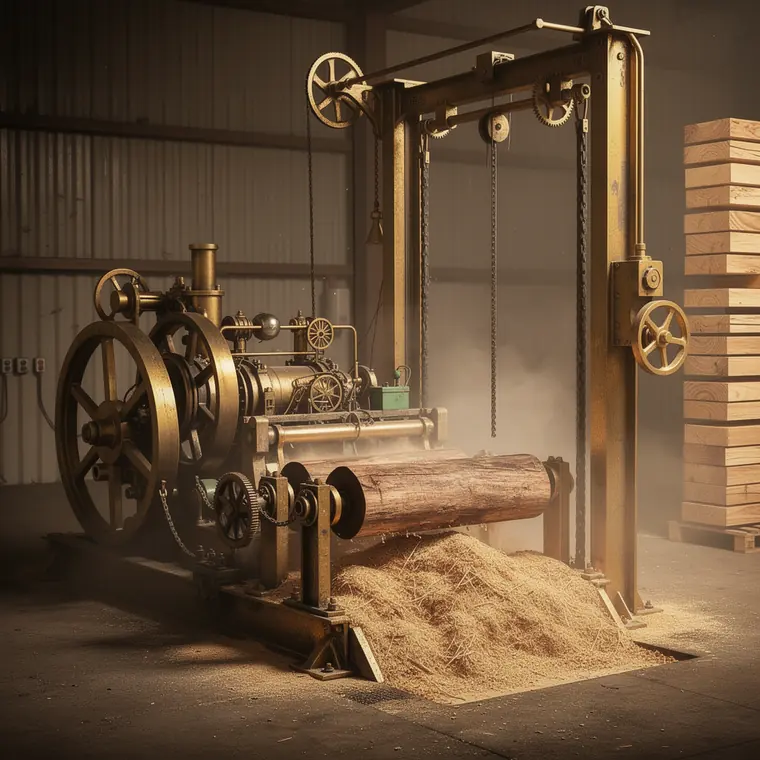
A sawmill engine driving a vertical frame saw, logs on the carriage waiting to enter, sawdust heaped below the blade, timber stacked outside the open shed.
- What it was used for
- The steam engine cut the sawmill loose from the river. Donald A. Hutslar puts it this way in the Ohio History Journal: a portable power source freed a mill from a fixed site near a pond or river and allowed the mill to be moved to the timber; it also let large saw and planing mills stand in the cities. The turnover can be read off a single state: the census counted 2,883 sawmills in Ohio in 1840; by 1870 there were 2,230 establishments running 3,177 saws, powered by 1,628 steam engines against 580 waterwheels and turbines - roughly three quarters of the drives were steam. In what is now West Virginia the number of steam sawmills rose from 15 in 1835 to over 400 by 1880.
- What was new
- What was new in 1840 was not the engine but the site. Steam sawmills had existed for decades: Brunel's sawmill at Chatham from 1812 to 1814 with a 24-horsepower engine, Darien in Georgia in 1818 with five gang saws, Saginaw in Michigan in 1834. What became new was that it was now routine: the mill went to the stand of timber and fired its boiler with its own waste - slabs, shavings, sawdust. That is also the price. In Michigan the Saginaw valley alone yielded a billion board feet in 1882. And the waste that fed the boiler also lay outdoors: in the Peshtigo fire of 8 October 1871, a Green Bay Press-Gazette account reprinted by the National Weather Service gives 1.2 to 1.5 million acres burned and more than 1,200 dead, 800 of them in the town itself. Other estimates run to 2,500; all these figures are estimates. That account attributes the ignition not to a sawmill but to railroad workers clearing land.
Further reading
- Donald A. Hutslar, Ohio Waterpowered Sawmills, Ohio History Journal Bd. 84 (Ohio History Connection)
- Historic England, Scheduled Monument 1021286: Brunel Sawmills, Chatham Dockyard
- e-WV: The West Virginia Encyclopedia (WV Humanities Council): Sawmills
- National Weather Service Green Bay: The Peshtigo Fire
- Georgia Historical Society, Marker: 200 Years of Sawmilling (Darien Eastern Steam Sawmill, 1818)
- Saginaw County Hall of Fame: Harvey Williams (erstes Dampfsägewerk 1834)
- City of Saginaw: Saginaw History (1882: 1.001.274.905 Brettfuß)
- University of Illinois Library Guide: Peshtigo Fire (Opferzahlen 1200 bis 2500)