Rolling Mill Engine
1860 · Rolling Mill · Work 99 of 1,871
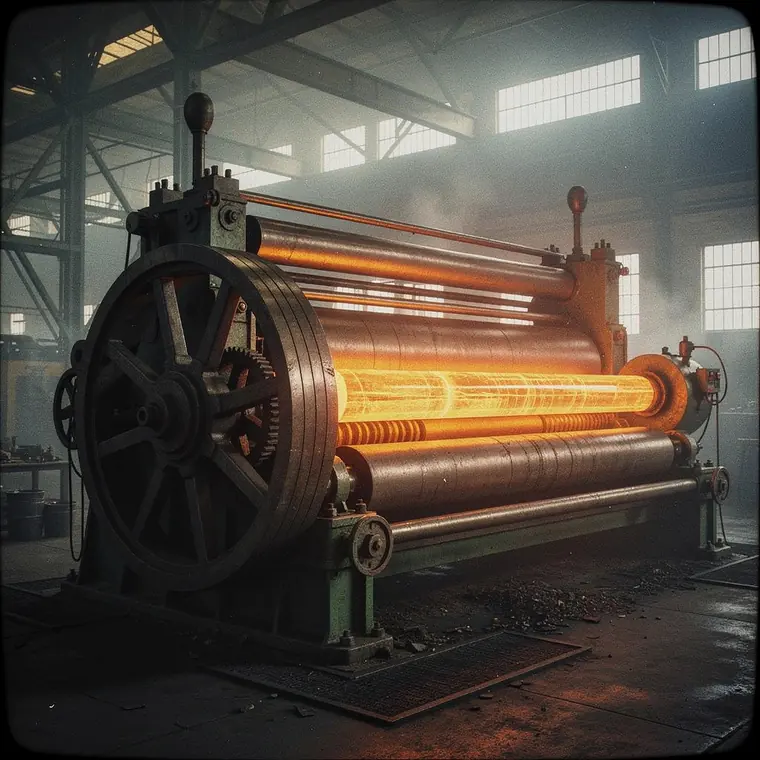
A reversing mill engine driving rolling stands, a glowing steel bloom passing between the rolls, flywheel of enormous diameter turning in the foreground.
- What it was used for
- It drove blooming, rail and plate mills. Lueger distinguishes two families, and the distinction matters more than it sounds: steam engines, mostly with flywheel, for trains running always the same way, and reversing engines for reversing trains, up to 20,000 hp. Documented examples: the blooming mill of the Dortmunder Union, built in 1894 by Gebr. Klein of Dahlbruch, a twin engine with 1,200 mm cylinders and 1,300 mm stroke, for ingots up to 2,500 kg and 450 by 450 mm in section; two men worked the control gear, with a roller stationed before and behind the rolls. The River Don Engine by Davy Brothers of Sheffield, 1905, 12,000 horsepower and 425 tons, rolled armour plate up to 40 cm thick and 50 tons in weight for Charles Cammell at Grimesthorpe. At Thale stands a superheated tandem compound rolling mill engine by Ascherslebener Maschinenbau AG of 1911: 1,500 hp, flywheel 6.8 m across and 120 tons; from 1912 to 1990 it drove all three stands of the blooming mill.
- What was new
- It was not the engine that was new but the compulsion. Bessemer relates in his autobiography that he had declared his process had rendered buildings full of puddling furnaces of little value, and that the weak old-fashioned rolling mills which would do for iron must all be replaced. What the new machines could do: reverse under load, so the ingot runs back and forth through one stand instead of through a row of stands in one direction. The barb is in the product. The autobiography, in a note added by his son, quotes Engineering of 5 January 1866 on a trial at Camden Goods Station: a steel rail rolled at Crewe and laid on 9 May 1862 had not once been turned by September 1864. The iron rail laid beside it on the same day had in that time been replaced six times - seven iron rails in all - each turned once before replacement. The price followed: a ton of Bessemer rails cost 22 pounds in 1861; in 1891-92 the average English price was 4 pounds 10 shillings.
Further reading
- Lueger, Lexikon der gesamten Technik: Walzenzugmaschinen (A. Widmaier)
- Polytechnisches Journal Bd. 301 (1896): Über Walzen und Walzwerke (nach Stahl und Eisen 1895)
- Sheffield Museums: River Don Engine
- Hüttenmuseum Thale: Heißdampf-Tandem-Verbund-Walzenzugmaschine 1911 (museum-digital)
- Sir Henry Bessemer, F.R.S.: An Autobiography, London 1905